
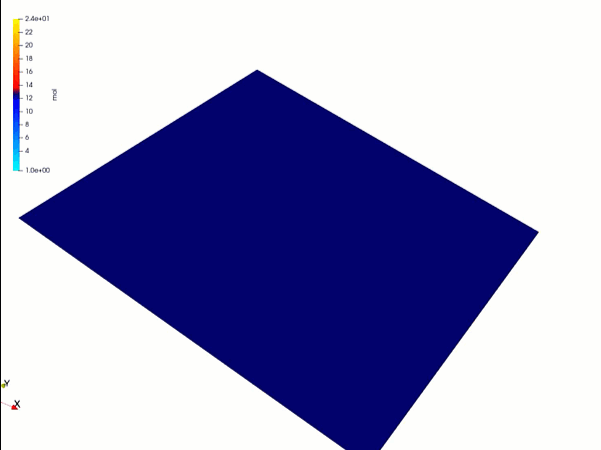
The Discrete Element Method (DEM) is a powerful numerical technique widely used to simulate the behavior of granular materials and particulate systems. While originally developed for rigid, spherical particles, recent advancements have expanded DEM to model long, flexible fibers. Simulating long fibers is crucial for industries dealing with textiles, composite materials, biomass handling, and mineral processing, where the entanglement and bending of elongated particles significantly affect material flow and structural properties.
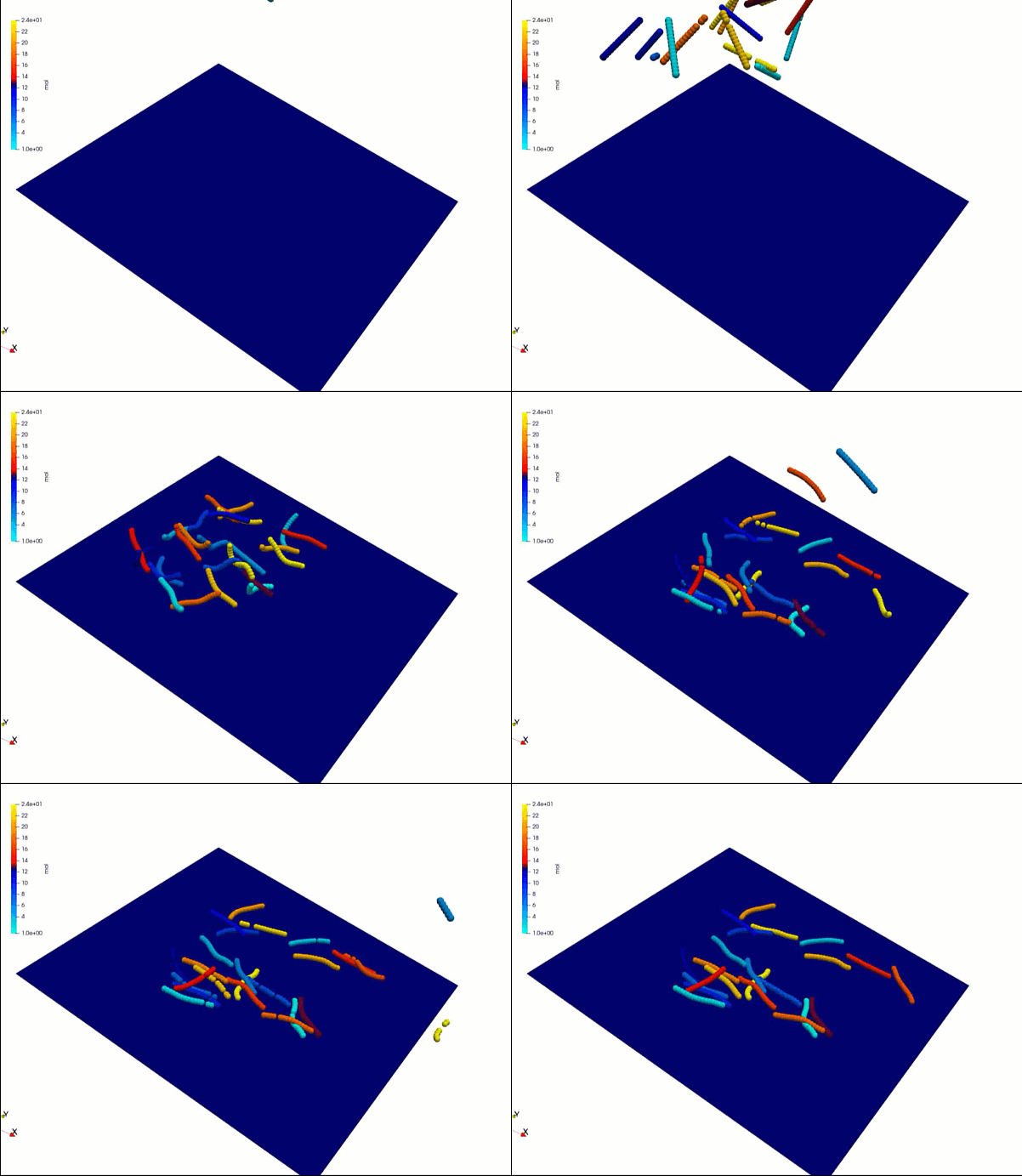
The Challenge of Elongated Particles
Standard DEM algorithms excel at tracking millions of independent spheres by detecting contacts and calculating overlapping forces. However, long fibers introduce complex physical behaviors—such as bending, twisting, stretching, and interlocking—that single spheres cannot capture. As a fiber’s aspect ratio increases, its mechanical response shifts from simple rigid body dynamics to complex structural deformation, requiring specialized modeling approaches within the DEM framework.
The Bonded Sphere Approach
The most common strategy for simulating long fibers in DEM is the bonded-particle model, often referred to as the “element chain” or “bead-on-string” approach. In this method, a single flexible fiber is represented as a chain of collinear, overlapping spheres connected by solid bonds. These bonds act as virtual springs and beams that resist stretching, bending, and twisting. When external forces act on the fiber, the bonds deform and transfer forces between adjacent spheres, allowing the entire chain to flex and behave like a continuous, slender rod.
Contact Detection and Interactions
Accurately capturing how fibers interact with each other and their environment is computationally intensive. DEM software must constantly track contacts not only between different fibers but also self-contacts where a single fiber loops and touches itself. When two fibers collide, the contact forces are typically calculated at the individual sphere level using standard Hertzian or linear spring-dashpot models. This approach allows the simulation to naturally capture macro-level phenomena like fiber entanglement, bird-nesting, and friction-induced clogging.
Coupling DEM with Other Methods
To model real-world manufacturing processes, DEM is frequently coupled with other numerical techniques. For instance, when simulating fibers in a fluid flow—such as in paper making or air-laid nonwoven production—DEM is combined with Computational Fluid Dynamics (CFD) such as OpenFOAM. In this coupled approach, the fluid forces exert drag and lift on the fiber spheres, while the motion of the fibers simultaneously alters the local fluid dynamics, providing a highly realistic view of multiphase flows.
Industrial Applications and Future Outlook
The ability to simulate long fibers opens up significant opportunities for industrial optimization. Engineers use fiber DEM to design efficient agricultural equipment for handling straw and switchgrass, optimize the mixing of fiber-reinforced concrete, and predict the behavior of carbon fibers in composite manufacturing. As high-performance computing and GPU-accelerated DEM solvers continue to evolve, simulating larger systems with tens of thousands of highly flexible, high-aspect-ratio fibers is becoming increasingly accessible, paving the way for more resilient material designs. To achieve this, researchers and engineers can efficiently simulate these complex fiber models using open-source packages like LIGGGHTS.
Author: Caesar Wiratama
Find me on Linkedin