
When engineers need to simulate how air flows over an electric car, how coolant moves through a microchip, or how waves impact an offshore wind turbine, they turn to Computational Fluid Dynamics (CFD). For decades, this highly complex field was dominated by restrictive, high-cost commercial software. OpenFOAM (Open-source Field Operation And Manipulation) shattered this monopoly. It has grown to become the undisputed global standard for free, open-source fluid simulation, trusted by Formula 1 teams, aerospace giants, and academic labs worldwide.
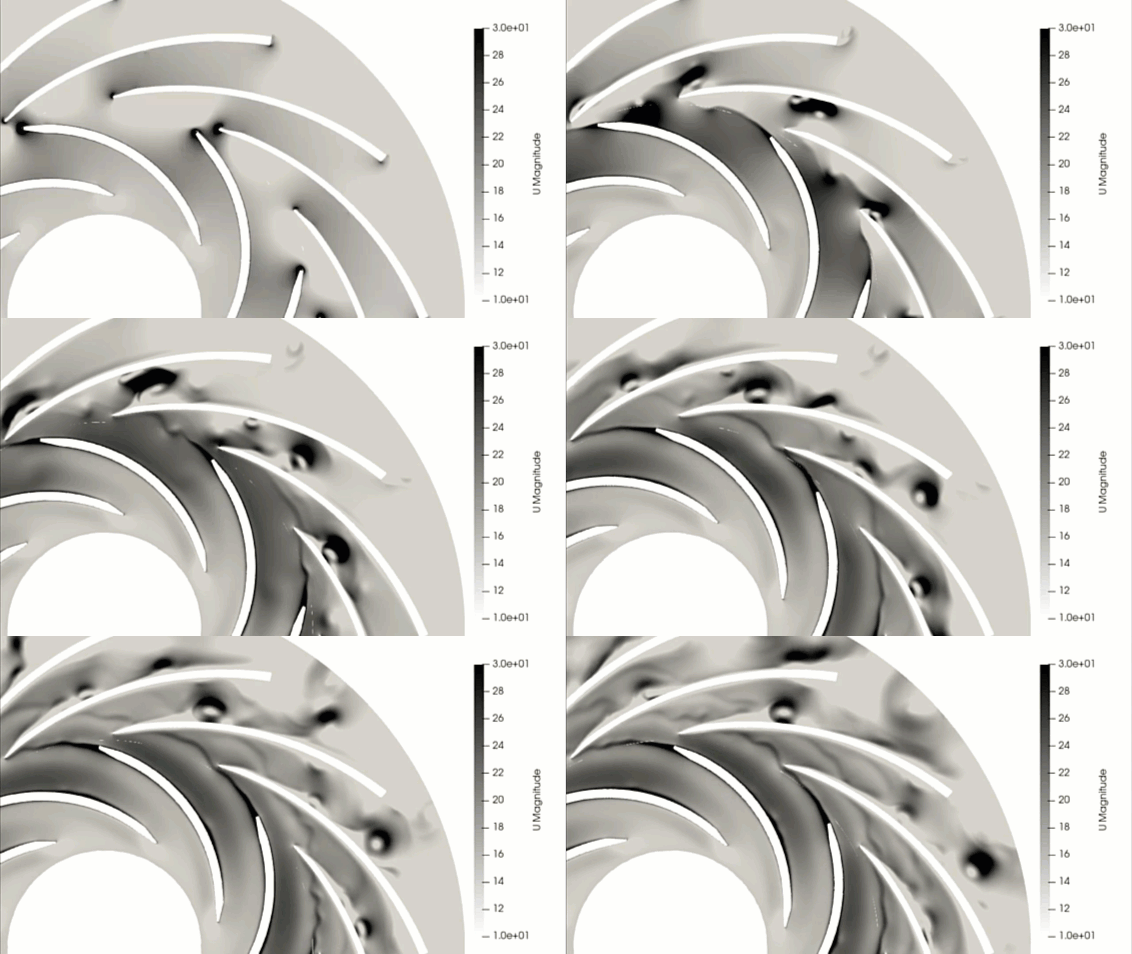
Originally released as open-source software in 2004 by Henry Weller and Chris Greenshields, OpenFOAM was built from the ground up to solve complex continuum mechanics problems. Today, it is managed primarily by the OpenFOAM Foundation and ESI Group, sustained by a massive global community of developers who continuously expand its capabilities.
An Architecture Built on C++ and Physics Cubes
Unlike commercial alternatives that bundle everything into a single visual application, OpenFOAM is a vast collection of modular C++ libraries. It treats physical phenomena—like turbulence, chemical reactions, or heat transfer—as interchangeable building blocks. At its structural core, OpenFOAM relies on the Finite Volume Method (FVM). It divides a 3D fluid domain into millions of tiny control volumes (cubes or polyhedrals) and tracks how mass, momentum, and energy move across their faces. Because it is written in highly object-oriented C++, advanced users can directly write new mathematical equations into the code, translating custom physics into high-performance software.
The Power of Text-Based Customization
To the uninitiated, OpenFOAM can look intimidating. By default, it has no graphical user interface (GUI). Instead, a simulation setup consists of a directory of text files known as “dictionaries.” Engineers define fluid properties, boundary conditions, and solver tolerances by editing these plain text files. While this creates a steep initial learning curve, it grants unparalleled power:
- Total Automation: Text-based configurations mean entire simulation workflows can be automated using simple Python or Bash scripts.
- No Licensing Walls: Because there are no graphical license keys to buy, engineers can deploy OpenFOAM across thousands of cloud-based CPU cores simultaneously via Message Passing Interface (MPI), unlocking massive parallel processing power for free.
Simulating Across Every Domain
OpenFOAM is not limited to basic airflow; its library includes hundreds of pre-built solvers tailored to specific industries. It contains specialized code for multiphase flows (such as mixing oil and water), compressible gas dynamics (for supersonic aerospace engineering), and combustion mechanics (for internal engines and burners). Additionally, OpenFOAM features advanced turbulence modeling tools, including Reynolds-Averaged Navier-Stokes (RANS), Large Eddy Simulation (LES), and Direct Numerical Simulation (DNS), allowing engineers to capture chaotic fluid behaviors with extreme mathematical precision.
The Anchor of the Modern CFD Ecosystem
Because OpenFOAM operates via standard text inputs and outputs, it serves as the ideal foundational engine for broader engineering ecosystems. To bypass the command-line interface, the open-source community frequently pairs OpenFOAM with graphical wrappers like HELYX-OS or BlueCFD-Core. For meshing complex spaces, OpenFOAM includes its own high-powered parallel meshers, snappyHexMesh and blockMesh. Finally, it outputs seamlessly to ParaView, the open-source post-processing standard, creating a completely free, end-to-end simulation pipeline that rivals any multi-million dollar commercial suite on the market.
Author: Caesar Wiratama
Find me on Linkedin
Related Search: FreeCAD Freelancing Service, code_aster Freelancing Service, Calculix Freelancing Service, OpenRadioss Freelancing Service, OpenFOAM Freelancing Service,
Validation studies:
- Dam-Break with Box CFD Simulation: OpenFOAM Validation Study (Kleefsman Benchmark)
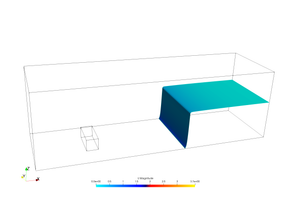 Author: Caesar Wiratama PT Tensor Karya Nusantara, wiratama@pt-tensor.com Abstract. This report documents an OpenFOAM recreation of the three-dimensional dam-break-with-box laboratory benchmark popularised by Kleefsman et al. and used by Sánchez-Cordero, Gómez and Bladé (2017) for OpenFOAM assessment. Transient free-surface flow is solved with interFoam (VOF) and RAS RNG k−ε on a structured multi-block hex mesh… Read more: Dam-Break with Box CFD Simulation: OpenFOAM Validation Study (Kleefsman Benchmark)
- Rack-Level Data-Center Airflow (Cold/Hot Aisle) CFD Simulation: OpenFOAM Validation Study
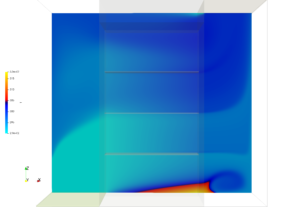 Author: Caesar Wiratama, M.S PT Tensor Karya Nusantara, wiratama@pt-tensor.com Abstract. This report documents an OpenFOAM recreation of the three-rack CEETHERM rack-level cold/hot-aisle benchmark of Saiyad, Fulpagare and Bhargav (Building Simulation, 2022). Steady buoyant airflow is solved with buoyantBoussinesqSimpleFoam and RAS RNGkEpsilon on a structured hex mesh. Geometry follows a 2.2 × 1.82 × 1.98… Read more: Rack-Level Data-Center Airflow (Cold/Hot Aisle) CFD Simulation: OpenFOAM Validation Study
- Thin Electronic Casing Cooling CFD–CHT Simulation: OpenFOAM Validation Study
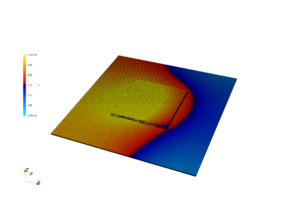 Author: Caesar Wiratama PT Tensor Karya Nusantara, wiratama@pt-tensor.com Abstract. This report documents an OpenFOAM conjugate heat-transfer (CHT) validation of forced airflow and package heating in the Hatakeyama thin electronic casing benchmark, used as a production baseline for the tensorECool template. Steady multi-region flow and heat transfer are solved with chtMultiRegionSimpleFoam and RAS kOmegaSST for three… Read more: Thin Electronic Casing Cooling CFD–CHT Simulation: OpenFOAM Validation Study
- Nielsen Heated-Floor Cavity CFD Simulation: OpenFOAM Validation Study
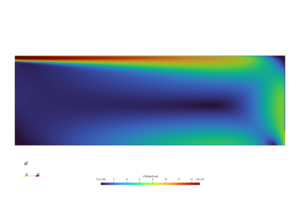 Author: Caesar Wiratama PT Tensor Karya Nusantara, wiratama@pt-tensor.com Abstract. This report documents an OpenFOAM validation of indoor mixed convection for the Nielsen heated-floor cavity, used as the production baseline for the tensorHVAC template. Steady buoyant airflow is solved with buoyantBoussinesqSimpleFoam and RAS RNGkEpsilon on a four-level structured grid ladder (52k–984k cells). Geometry, inlet jet, floor… Read more: Nielsen Heated-Floor Cavity CFD Simulation: OpenFOAM Validation Study
- Segmental Shell-and-Tube Heat Exchanger Mesh and Mass-Flow Sensitivity: OpenFOAM Validation Study
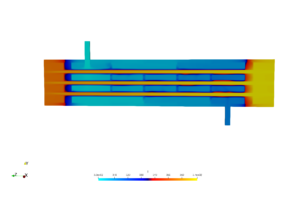 Author: Caesar Wiratama PT Tensor Karya Nusantara, wiratama@pt-tensor.com Abstract. This report documents an OpenFOAM conjugate-heat-transfer validation of a laboratory-scale segmental baffle shell-and-tube heat exchanger (SG-STHX) used as the production baseline for the tensorSTHE template. A structured multi-region mesh (CFD-mesh01, ~1.45 M cells) is solved with chtMultiRegionSimpleFoam and RAS kOmegaSST. Heat transfer rate Q and shell-side… Read more: Segmental Shell-and-Tube Heat Exchanger Mesh and Mass-Flow Sensitivity: OpenFOAM Validation Study
- Ahmed Bluff Body OpenFOAM Validation Study: Mesh and Reynolds Number Sensitivity Studies
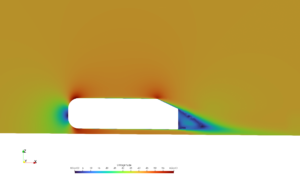 Author: Caesar Wiratama, M.S PT Tensor Karya Nusantara, Wiratama@pt-tensor.com Abstract. This report documents an OpenFOAM validation of the classic Ahmed bluff body at 25° slant angle. A production baseline (CFD) was established at U∞ = 40 m/s, followed by a three-level grid-independence study (GIT) and a three-point Reynolds-number sensitivity analysis. Force coefficients Cd and Cl… Read more: Ahmed Bluff Body OpenFOAM Validation Study: Mesh and Reynolds Number Sensitivity Studies