
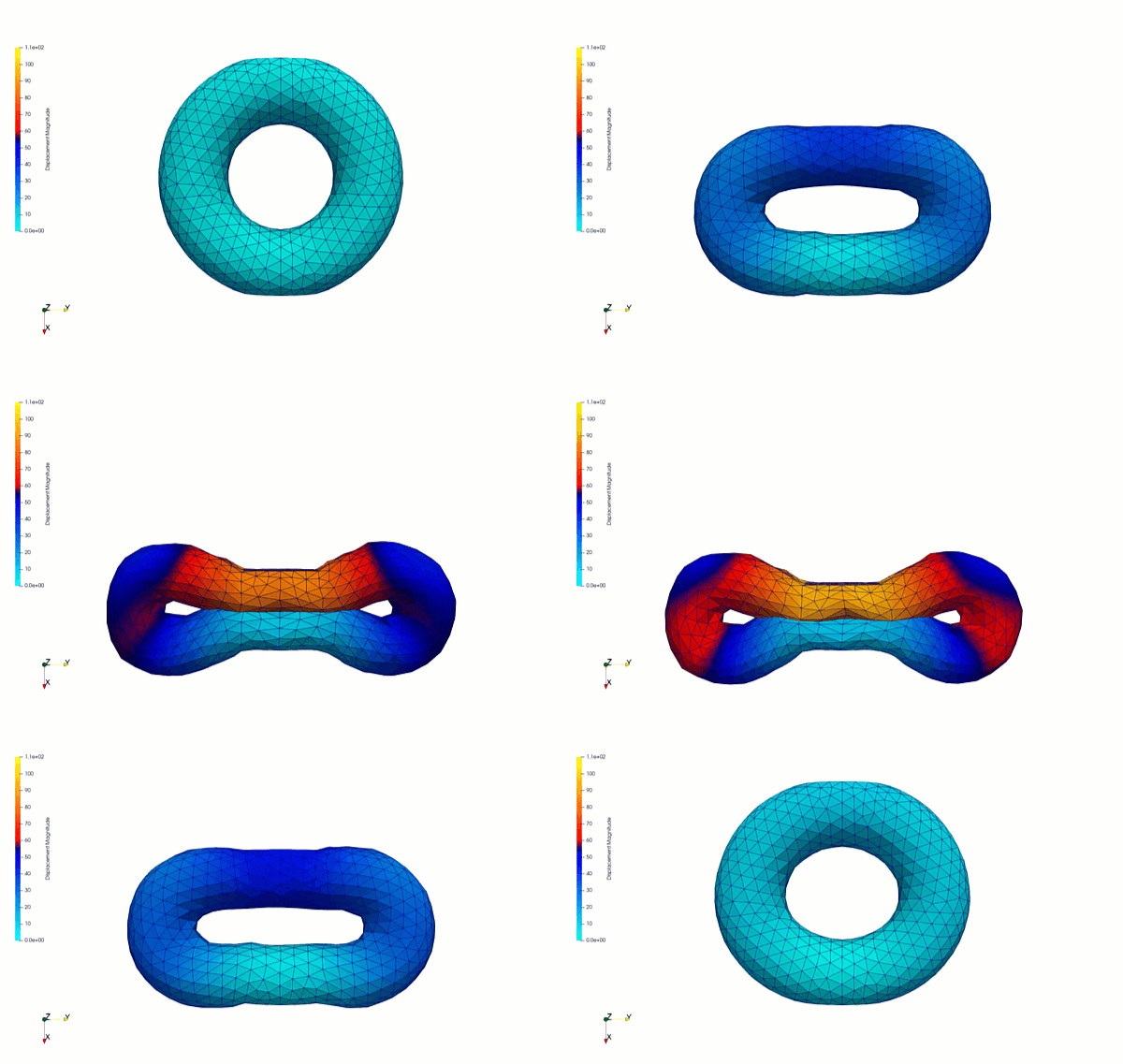
Designing products that utilize hyperelastic materials, such as rubber seals, or non-linear materials, like engineering plastics, requires analysis tools that go beyond linear physics. Rubber does not follow standard structural rules; it undergoes massive deformation under load, changes its stiffness continuously, and maintains its volume when compressed. Plastics exhibit permanent deformation once they pass their yield point, meaning they stretch or bend permanently rather than snapping back. Non-linear FEA allows engineers to accurately capture these complex material laws using mathematical models like Mooney-Rivlin or Ogden for rubbers, and plastic-hardening curves for polymers. This predictive accuracy ensures that snap-fit joints do not snap during assembly, and rubber gaskets maintain a perfect seal without tearing.
Financial Payoffs in Tooling and Material Selection
For rubber and plastic components, the financial savings of non-linear FEA are heavily concentrated in tooling and manufacturing costs. Producing injection molds or compression tooling for plastic and rubber parts is an expensive process, often costing tens of thousands of dollars per mold. If a physical prototype reveals that a plastic snap feature breaks or a rubber seal buckles incorrectly, the physical mold must be modified or completely scrapped. Non-linear simulation allows engineers to optimize wall thicknesses, evaluate rib reinforcements, and test assembly forces digitally before the first mold is cut. Catching a design flaw in software rather than on the manufacturing floor prevents costly tooling re-work and minimizes material waste during initial production trials.
Leveraging Open-Source Solvers for Advanced Polymers
Simulating polymers and elastomers usually demands premium, high-tier software packages that add substantial overhead to engineering budgets. Open-source solvers break down this financial barrier by providing advanced non-linear material models completely free of licensing constraints. Engineers can run large, complex simulations across multiple computing cores simultaneously without worrying about escalating software fees. This accessibility allows companies to rigorously test different material grades—comparing a cheaper polymer against a premium one—in a virtual environment, optimizing both the product’s performance and its raw material cost structure.
OpenRadioss for Plastic Snaps and High-Strain Failure
For plastic and rubber products subjected to sudden forces, OpenRadioss provides the explicit analysis needed to simulate high-strain rate behaviors. When a plastic enclosure drops, the material behaves differently than it does under a slow, steady force; it becomes more brittle and prone to cracking. OpenRadioss excels at capturing this rapid material failure, localized buckling, and the high-speed deployment of flexible components. Designers use it to simulate the impact performance of consumer electronics casing, the flexing of living hinges, and the energy absorption of rubber bumpers, ensuring the product survives real-world drops without needing to run destructive laboratory tests on physical plastic housings.
Code_Aster for Complex Elastomeric Seals and Creep
When dealing with the long-term reliability of rubber seals, gaskets, and complex polymer assemblies, Code_Aster offers a highly advanced implicit solver. Rubber components under sustained load suffer from stress relaxation and creep, meaning they lose their sealing force over time, especially when exposed to heat. Code_Aster features a comprehensive library of hyperelastic and viscoelastic material formulations specifically designed to handle these behaviors. By using Code_Aster, companies can simulate how a rubber automotive seal performs over years of exposure to engine heat and mechanical compression, preventing catastrophic field failures and expensive warranty claims down the line.
CalculiX for Efficient Non-Linear Contact and Gaskets
For everyday engineering tasks involving non-linear materials, CalculiX provides a highly efficient and accessible implicit solver to evaluate press-fits and gasket sealing pressures. A major challenge with rubber and plastic design is handling “contact non-linearity”—where two parts touch, slide, and deform against each other, changing the load path continuously. CalculiX handles these complex contact problems smoothly alongside hyperelastic material models. Engineers use it to quickly check if a rubber O-ring is compressing adequately within its groove or to calculate the force required to push a plastic pin into a receptacle, offering a streamlined workflow that mimics expensive proprietary alternatives.’
Author: Caesar Wiratama
Find me on Linkedin