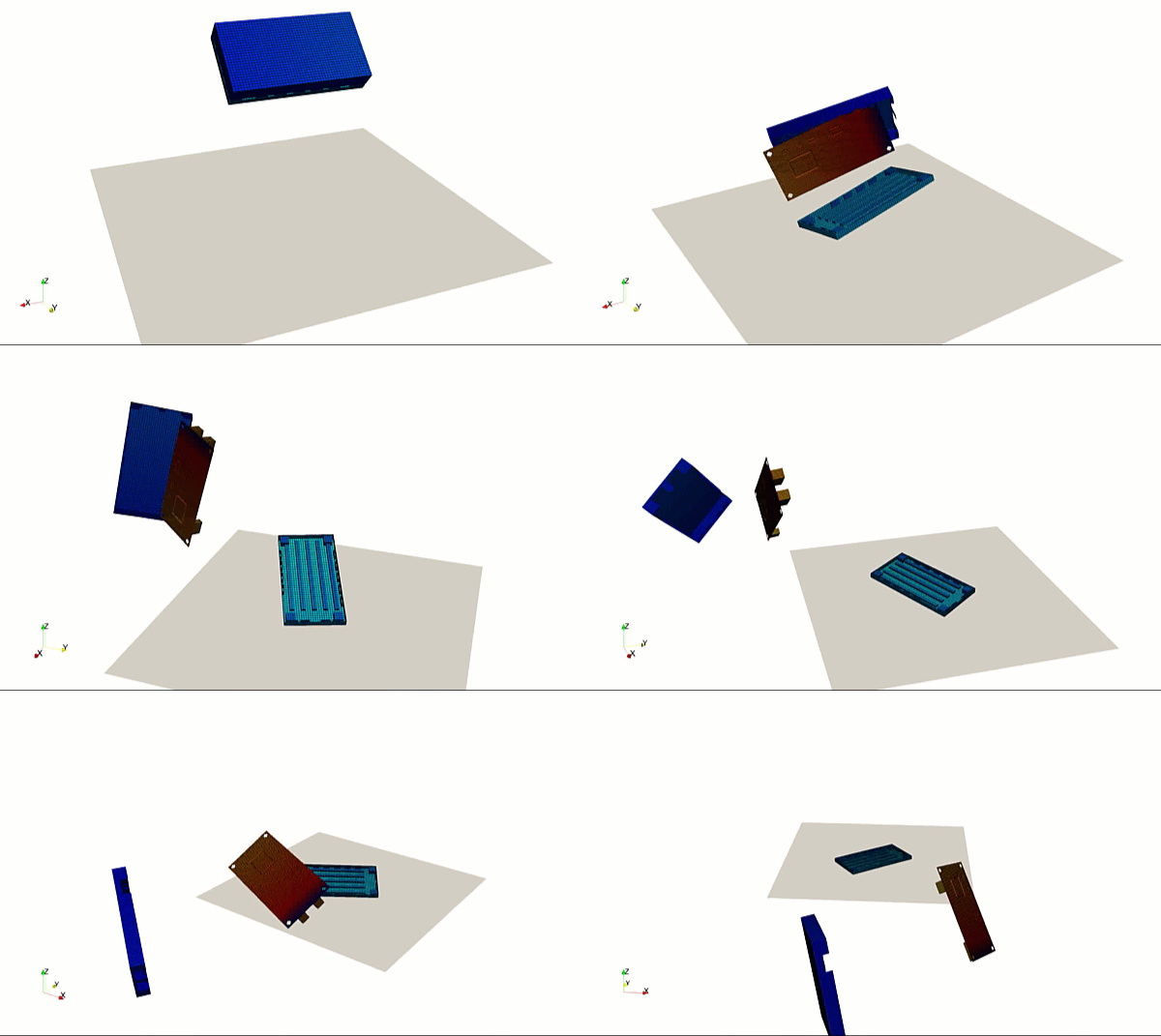
In structural engineering, simulating high-velocity impacts—such as a car crashing into a concrete wall or a smartphone dropping onto a hardwood floor—presents an extreme mathematical challenge. These scenarios belong to a domain called explicit dynamics, where structural deformations happen in milliseconds and materials behave unpredictably under intense stress. For decades, this specialized field was locked behind exceptionally expensive commercial software. OpenRadioss disrupted this status quo, emerging as a high-powered, open-source explicit simulation engine capable of industrial-grade crash and impact analysis.
Unlike many open-source projects that began in academic labs, OpenRadioss has a rich commercial pedigree. It was originally developed as Radioss, a premier commercial solver owned by the engineering software giant Altair. In a landmark move for the Computer-Aided Engineering (CAE) community in September 2022, Altair open-sourced the entire codebase. This sudden transition instantly injected over 30 years of industrial development, tuning, and validation into the open-source ecosystem.
The Mechanics of Explicit Dynamics
To appreciate OpenRadioss, it helps to understand its computational engine. Standard structural software uses implicit solvers, which calculate structural equilibrium over large blocks of time—ideal for bridges holding steady weight. OpenRadioss uses an explicit solver, which calculates physical changes by marching through time in microsecond steps without needing to solve massive, interconnected matrix equations all at once. This architecture makes it exceptionally stable when tracking rapid structural changes, stress wave propagation, and chaotic interactions like metal buckling, tearing, and splintering.
Unmatched Fidelity in Material and Contact Physics
Explicit simulations are only as accurate as the mathematical models driving them. OpenRadioss features a vast built-in library of highly advanced material laws and failure criteria. It can accurately predict how steels, aluminum alloys, composite plastics, foams, and biomaterials react when pushed past their breaking points under high strain rates. Furthermore, it excels at complex contact-impact physics. When an automobile bumper crushes inward, hundreds of individual metal folds collide and slide against each other. OpenRadioss uses robust self-contact algorithms to track these multi-surface interactions accurately without crashing the computation.
Scalability on High-Performance Computing (HPC)
Crash tests require immense computing power, often utilizing hundreds of millions of mesh cells. OpenRadioss was engineered from its inception to run efficiently across modern parallel computing architectures. Using Hybrid Parallelization (a combination of MPI and OpenMP), the solver splits massive simulation models across hundreds or thousands of high-performance CPU cores. Because it is open-source, engineering firms and research labs can scale their cloud-based crash testing simulations infinitely to achieve overnight results, entirely free from the burden of per-core commercial software licensing fees.
Integrating into the Global CAE Workflow
OpenRadioss does not seek to replace existing engineering pipelines; it is designed to seamlessly enhance them. It retains compatibility with standard file formats widely used in the automotive and aerospace industries. For engineers building an open-source CAE ecosystem, OpenRadioss easily integrates with open pre-processors for mesh generation and exports its final results natively to ParaView for interactive, high-framerate 3D animations of destruction and impacts. By democratizing access to top-tier explicit dynamics, OpenRadioss has truly leveled the playing field for global product safety and structural innovation.
Author: Caesar Wiratama
Find me on Linkedin
Related Search: FreeCAD Freelancing Service, code_aster Freelancing Service, Calculix Freelancing Service, OpenRadioss Freelancing Service, OpenFOAM Freelancing Service,