
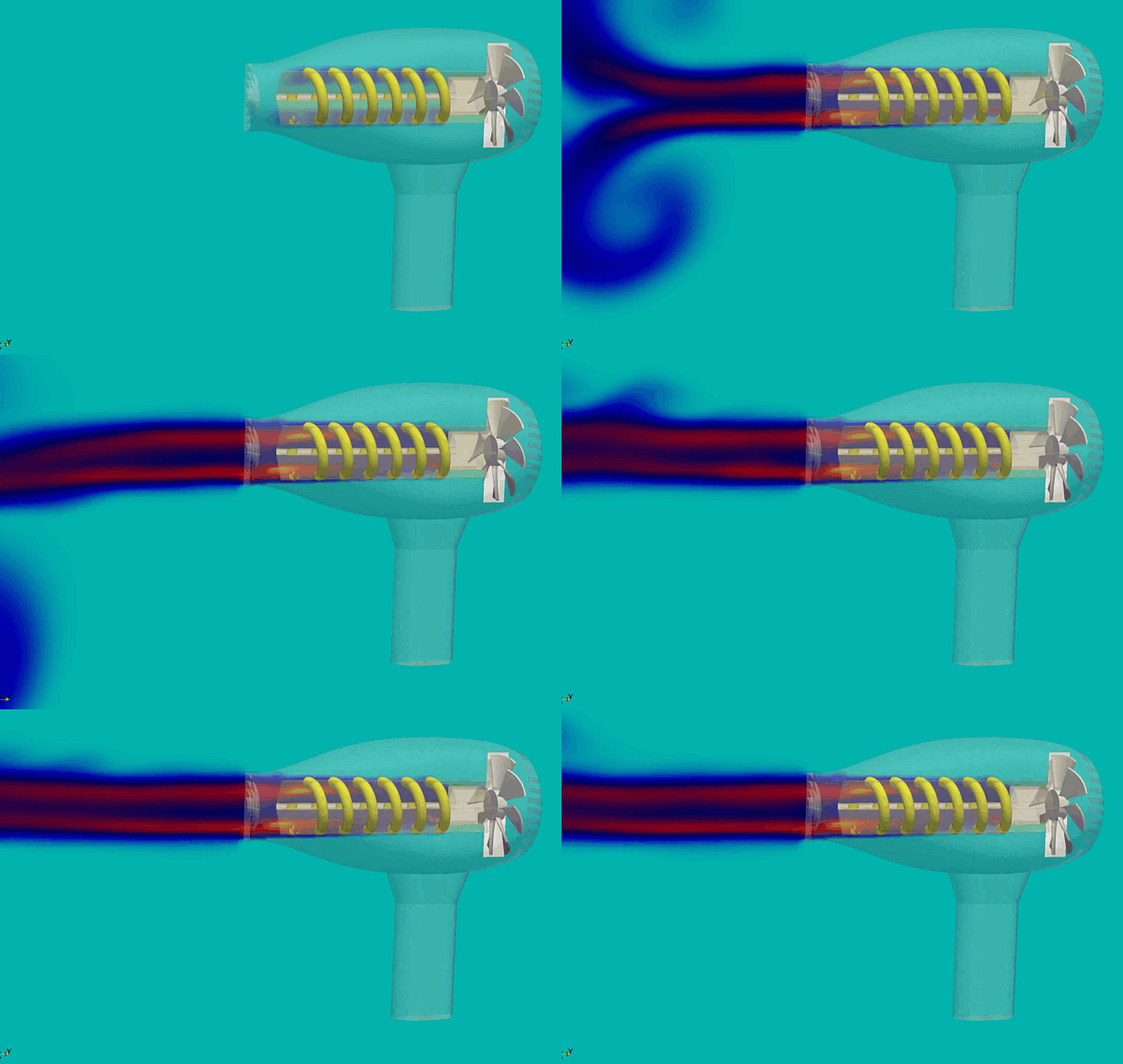
In hardware manufacturing, discovering a design flaw late in the production cycle is an expensive nightmare. For a hair dryer, a seemingly minor mistake—such as an inefficient fan blade angle, poor internal component spacing, or a miscalculated heating element placement—can cause localized overheating, excessive noise, or weak airflow.
If these issues are caught only after physical tooling and injection molds have been created, the financial impact is devastating. Re-tooling a single plastic injection mold can cost tens of thousands of dollars and add months to the development timeline. If the flaw slips through to production, the consequences escalate to massive product recalls, warranty claims, and irreparable damage to a startup’s brand reputation. In a competitive market, a six-month delay due to design redesigns can mean missing critical holiday sales windows, allowing competitors to capture the market share entirely.
Revolutionizing the Design Workflow with High-Fidelity CFD
High-fidelity CFD simulation allows engineers to peer inside the hair dryer virtually, visualizing how air and heat move through the device before a single piece of hardware is built. Using CFD, a design team can simulate the entire internal environment of the hair dryer. This includes the intake grill, the high-speed rotation of the impeller, the thermal energy transfer from the heating coils, and the final exit velocity at the nozzle.
Engineers can test dozens of design iterations in parallel. They can alter the curvature of the handle, adjust the number of fan blades, or move internal electronics to see exactly how these changes affect pressure drop and thermal distribution. Instead of waiting weeks for a machine shop to cut a prototype, a startup can evaluate a new design variant in a matter of hours.
Leveraging OpenFOAM for Cost-Effective, Advanced Engineering
For startups operating on lean budgets, commercial CFD software licenses can be prohibitively expensive, often costing tens of thousands of dollars per user annually. This is where OpenFOAM (Open Source Field Operation and Manipulation) becomes a strategic game-changer. As a free, open-source CFD toolbox, OpenFOAM gives startups access to top-tier, enterprise-grade simulation capabilities without the financial barrier.
OpenFOAM excels at handling the specific, complex physics required for hair dryer design. Its transient solvers can accurately capture the turbulent, swirling airflow generated by the motor. Using Conjugate Heat Transfer (CHT) solvers, OpenFOAM can simultaneously simulate how heat transfers from the solid heating elements into the fluid air stream. Furthermore, because OpenFOAM has no licensing limits on the number of processor cores used, startups can leverage affordable cloud computing to run massive, highly detailed simulation meshes simultaneously, drastically accelerating their engineering pipeline.
From Virtual Insights to Market Success
By shifting the core validation process from physical testing to high-fidelity OpenFOAM simulations, startups can confidently lock in their designs before investing in manufacturing infrastructure. Physical prototypes are still used, but only at the very end of the cycle for final compliance certification and quality assurance, rather than for trial-and-error troubleshooting.
Ultimately, utilizing CFD simulation transforms engineering from a game of guesswork into a predictable science. It ensures that the first physical product rolling off the assembly line performs exactly as intended. For hardware startups and manufacturers, this digital-first approach eliminates the risk of costly re-tooling delays, slashes development expenses, and delivers a superior, high-performance product to the market well ahead of the competition.
Author: Caesar Wiratama
Find me on Linkedin