
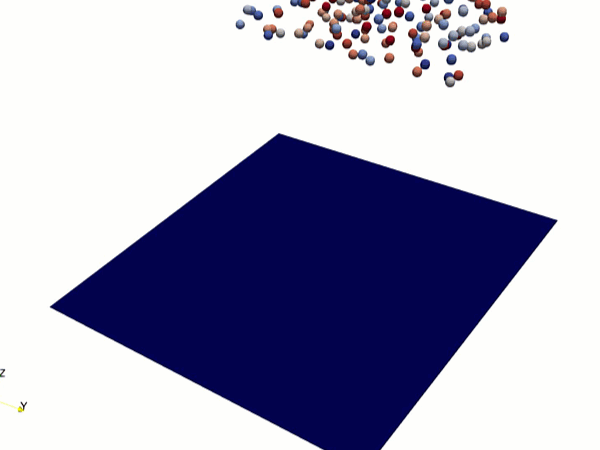
In bulk materials handling and processing industries—spanning mining, pharmaceutical manufacturing, agricultural logistics, and civil construction—granular solids represent the most volatile, erratic, and unpredictable materials on a production line. From sticky cohesion in iron ore chutes to severe particle segregation in rotating tablet drums, bulk solids can behave like an unpredictable hybrid of solid, liquid, and gas.
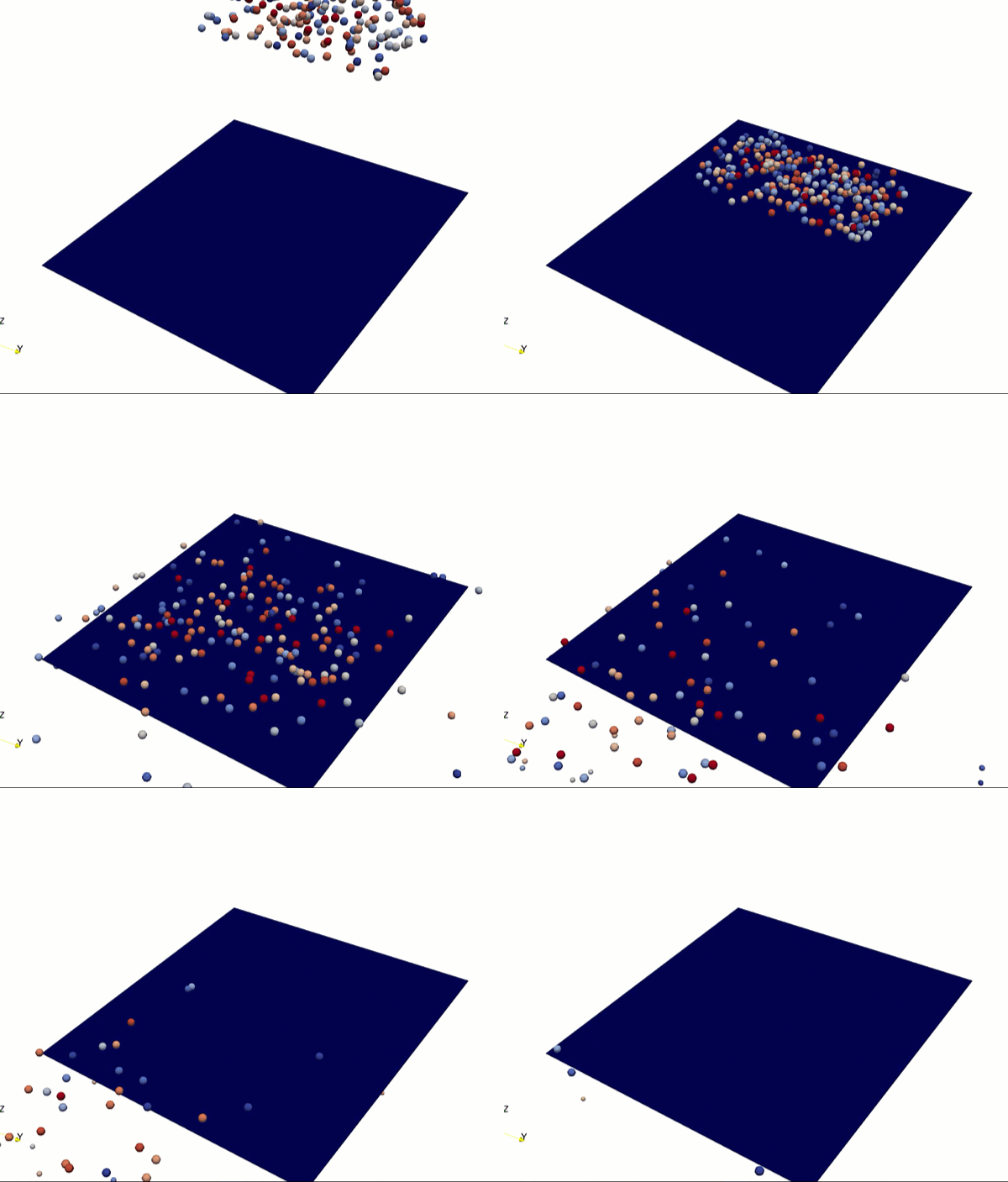
To design equipment that prevents catastrophic flow blockages and minimizes mechanical wear, engineering teams rely heavily on the Discrete Element Method (DEM). By simulating the explicit trajectory, collision physics, and contact forces of millions of individual particles, DEM transforms empirical guesswork into high-fidelity, predictive mechanical design.
Operating a bulk material system efficiently requires maximizing throughput and optimizing flow paths while strictly minimizing abrasive wear on contact linings and avoiding structural blockages. Because real-world granular flows are deeply influenced by particle shape, surface friction, and material moisture, engineering teams deploy DEM to optimize transfer chute geometries, calculate optimal conveyor transfer speeds, and design long-lasting liner plates.
However, simulating bulk material behavior is an exceptionally deceptive, highly discontinuous physics challenge. Granular materials change state dynamically—transitioning from static, solid-like arches to rapid, fluid-like shear streams within fractions of a second. If your simulation framework relies on simplified continuum approximations or defaults to smooth, perfectly spherical particle models, your solver will suffer from unphysical flow rates and false discharge velocities—leaving your design team with highly inaccurate equipment lifespan maps.
1. The Physics Anchor: Contact Mechanics and Particle State Transitions
The structural behavior and multi-phase kinematics inside a bulk handling system are governed by a Lagrangian tracking framework coupled with explicit contact mechanics. The material behavior maps a highly non-linear physical sequence:
\(\text{[Static\ Bulk\ Rest]}\rightarrow \text{[External\ Force\ Overcomes\ Friction]}\rightarrow \text{[Particle-to-Particle\ Collision\ Energy\ Transfer]}\rightarrow \text{[Rapid\ Shear\ Flow\ State]}\rightarrow \text{[Energy\ Dissipation\ \&\ Realignment]}\)
- The Contact Force Topology: Unlike continuous fluids, granular materials transmit forces through a dynamically evolving network of force chains. DEM computes these interactions at every discrete contact point by resolving normal and tangential displacement vectors. To capture this mathematically, the solver utilizes contact models (such as the Hertz-Mindlin non-linear spring-dashpot formulation) to calculate the elastic deformation, viscous damping, and frictional sliding resistance occurring across micro-second contact intervals.
- The Shape-Induced Mechanical Interlocking: Real-world particles are rarely perfect spheres. As angular rocks, jagged grains, or elongated pills flow past one another, their geometric irregularities cause mechanical interlocking, generating a high macroscopic angle of repose and internal shear strength. To track these tight, twisting physical orientations, modern DEM solvers utilize multi-sphere clusters, polyhedral elements, or non-spherical superquadric formulations. If the solver fails to account for this geometric friction, particles will unrealistically roll rather than slide, completely miscalculating structural bridging and mass-flow boundaries.
2. Industry Context: Where Granular Physics Secures Plant Infrastructure
Optimizing material transit paths and managing particle-impact energy through high-fidelity DEM directly dictates the uptime, maintenance cycles, and capital longevity of heavy industrial facilities:
- Mining and Mineral Processing Transfer Chutes: Mining operations route thousands of tons of abrasive run-of-mine ore through massive conveyor transfer points every hour. Engineers deploy wear-coupled DEM to map the precise impact angles and cumulative normal energy fields on chute walls. This allows them to position sacrificial wear liners strategically, preventing localized burn-through that could cause an unscheduled, multi-million-dollar plant shutdown.
- Pharmaceutical Powder Blenders: Manufacturing stable, uniform pharmaceutical tablets requires achieving a perfectly homogeneous mixture of active ingredients and excipients. Engineers use DEM to analyze the convective and diffusive mixing rates inside V-blenders and continuous granulators. This ensures that micro-scale components do not segregate due to size differences, guaranteeing strict compliance with clinical dosage safety standards.
- Agricultural Harvesting and Seeding Equipment: High-throughput agricultural machinery must handle delicate grains and varying soil profiles without causing crop damage or equipment clogging. Designers use calibrated DEM simulations to optimize the flight pitch of augers, the tooth profiles of threshing cylinders, and the seed-soil interaction of planters, maximizing processing speeds while preserving crop quality.
3. The Traps & Friction: Why Granular DEM Fails
Predicting the exact mass flow rate and real-world abrasive wear pattern inside a high-throughput processing zone requires avoiding severe numerical and physical traps:
- Relying on Uncalibrated Micro-Parameters: The most common and destructive pitfall in discrete element modeling is defaulting to generic textbook values for particle stiffness, static friction, and the coefficient of restitution. DEM micro-parameters do not always map directly to real-world handbooks; instead, they are collective representations of microscopic interactions. If a team skips the physical calibration phase, an over-predicted friction coefficient will artificially generate an immovable material arch in a hopper simulation that would actually flow perfectly on the factory floor.
- Utilizing Artificially Scaled Particles to Speed Up Runtimes: To minimize processing times across large industrial layouts, engineers frequently scale up the simulation particle sizes (e.g., modeling 10 mm grains as 50 mm spheres) to reduce the total particle count. However, altering the particle size radically changes the internal void ratio, mass distribution, and interlocking mechanics. This artificial scaling flattens the chaotic, localized stress distributions, smoothing over potential jamming points and outputting overly optimistic throughput curves.
- Using Coarse Time Steps That Exceed the Rayleigh Limit: The highest velocity transitions and impact forces occur during fractions of a millisecond as particles collide. If the simulation time step is set too large to save computation time, particles will “overlap” too deeply within a single step. The mathematical solver will suffer from severe numerical energy spikes, creating an unphysical explosion of particles that completely invalidates the system’s permanent energy loss and force distribution.
4. Conquering the Granular Boundary
A beautiful, color-coded animation of particles cascading through an industrial mixer is completely useless if your digital throughput and wear maps do not correlate with physical plant telemetry. Validating your DEM engineering pipeline requires moving past uncalibrated spherical shortcuts and deploying GPU-accelerated, shape-accurate, and multi-phase coupled workflows (such as DEM-CFD for fluid-particle interactions) that naturally handle complex material behavior.
Your simulation parameters must be cross-referenced against empirical laboratory and field metrics—such as physical angle-of-repose tests, draw-down hopper discharge times, and localized shear cell measurements. This ensures your non-linear contact parameters, real-world geometries, and transient force-chain structures perfectly reflect physical industrial processing boundaries.
Author: Caesar Wiratama
Find me on Linkedin