
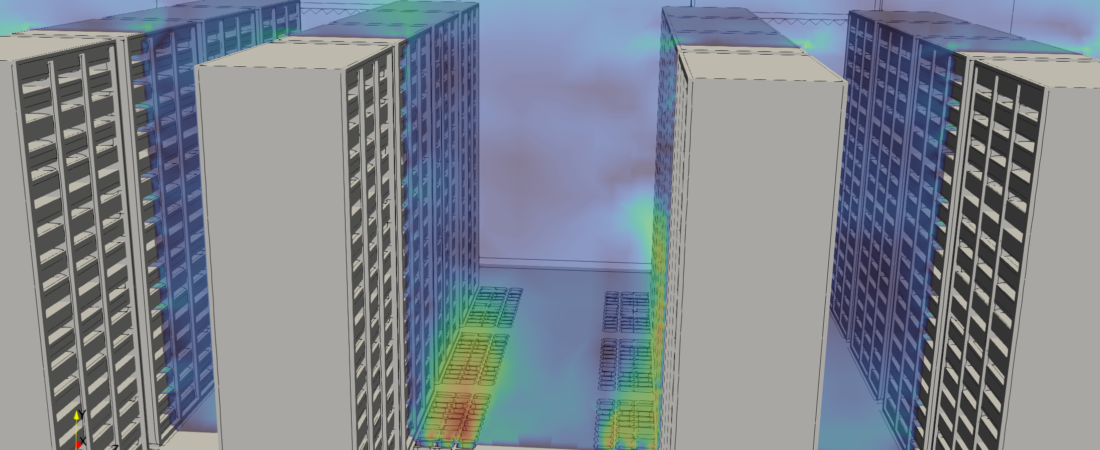
Data centers function as the core physical backbone supporting modern computing, spanning from localized server rooms to hyperscale cloud facilities. Driven by an exponential surge in artificial intelligence training, high-density computing workloads, and global digital traffic, these facilities have quickly become some of the fastest-growing consumers of electricity in the nation. Recent market data reveals that U.S. data center electricity consumption accelerated sharply to over 312 billion kilowatt-hours (kWh) annually, capturing approximately 6% to 7% of total national electricity demand. Because cooling infrastructure accounts for 35% to 55% of a facility’s total power load, optimizing thermal efficiency has become the primary mechanism for lowering operational expenses and stabilizing Power Usage Effectiveness (PUE) metrics.
The Core Inefficiencies of Over-Cooling
The single largest contributor to poor PUE within data halls is the systemic habit of over-cooling. Due to inadequate airflow management, an average of only 60% of the cold air delivered by computer room air conditioning (CRAC) units effectively reaches active IT hardware. To compensate for this bypass air and prevent critical components from overheating, operators frequently drop supply air temperatures up to 8°C colder than necessary to maintain ASHRAE TC 9.9 thermal guidelines. This widespread safety margin leads to considerable energy waste, overloading thermal management systems and drastically increasing utility costs.
A Tiered Framework for Airflow Control
Organizations can deploy several physical optimization strategies to systematically isolate hot exhaust air from cold intake air currents:
- Blanking Panels: These plates seal off unpopulated rack spaces, forcing supply air directly through active server chassis rather than allowing it to escape around the perimeter.
- Hot/Cold Aisle Orientation: This layout faces server intakes toward one another to form dedicated cold delivery rows, while reversing adjacent racks to vent exhaust into isolated hot aisles.
- Optimized Floor Tile Distribution: Placing specific perforated tiles and diffusers directly matches local airflow rates with variable rack power densities, though complex fluid dynamics require careful tuning to ensure even distribution.
- Aisle Containment Structures: Sealing entire hot or cold rows behind rigid metal, plastic, or plexiglass partitions forms an isolated thermal room, virtually eliminating air mixing and cold bypass.
Diagnosing Baseline Irregularities with CFD
Evaluating the economic return on containment modifications requires building an accurate baseline model through three-dimensional Computational Fluid Dynamics (CFD). In a standard engineering evaluation of a 6 kW-per-rack hot/cold aisle layout with 50% porous floor tiles, CFD velocity simulations map exactly how cold supply air behaves. The results demonstrate that native air plumes frequently bypass the forward server inlets entirely, rushing toward the rear of the room or escaping directly to the ceiling. This poor distribution causes intake temperatures to spike up to 34°C—a severe 22°C variance above the CRAC supply temperature—creating dangerous localized hot spots that mimic real-world hardware failures.
Quantifying the Containment Turnaround
Visualizing the internal airflow streamlines explains the root cause of these localized thermal spikes. Hot exhaust air recirculates from the furthest server rows, mixing with the pristine cold supply stream before it can enter active hardware intakes closer to the CRAC unit. Furthermore, unsealed 2-inch gaps at the floor level and 1-inch spaces between adjacent server cabinets create localized pressure drops, drawing exhaust air backward into the rack base. Running a comparative CFD simulation with full blanking panels and an enclosed cold aisle containment structure changes the fluid dynamics entirely, producing a perfectly uniform 12°C supply air isosurface across all server faces.
Engineering Actionable Efficiency Gains
Using advanced numerical fluid modeling allows data center operators to transition away from speculative adjustments toward data-driven retrofits. Proving these step-wise efficiency gains via CFD confirms that implementing aisle containment and blanking plates enables operators to safely increase their core CRAC setpoints by 2°C to 10°C. This shift significantly improves ASHRAE compliance margins while directly lowering the facility’s PUE. With validated thermodynamic data in hand, engineering teams can execute exact cost-benefit analyses to ensure that infrastructure upgrades yield immediate, measurable power reduction.
Author: Caesar Wiratama
Find me on Linkedin