
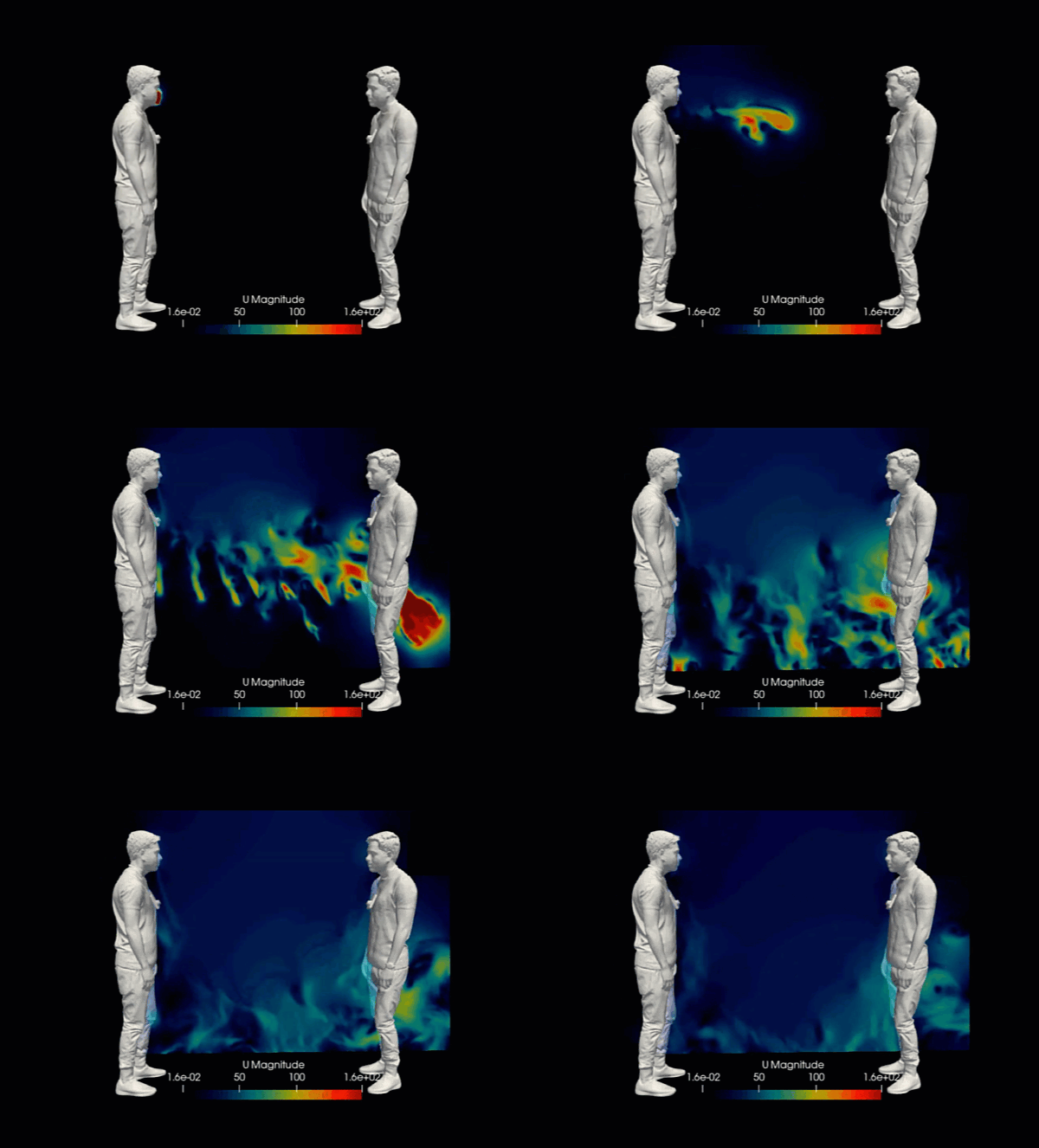
The airborne transmission of respiratory pathogens is a primary vector for public health risks, driving the spread of viruses such as influenza, tuberculosis, and coronaviruses within enclosed environments. When an infected individual coughs or sneezes, they release a high-velocity multi-phase plume containing millions of microscopic saliva and mucus droplets embedded with viral loads. Understanding how these infectious particles disperse, evaporate, and interact with indoor airflow is critical for designing effective public health guidelines, social distancing metrics, and safe ventilation systems. Computational Fluid Dynamics (CFD) provides epidemiologists and building safety engineers with an invaluable virtual laboratory to map transient droplet trajectories, track viral concentrations, and evaluate protective counter-measures with high precision.
Technical and Theoretical Description
From a physical perspective, a human coughing event operates on highly transient, multi-component, multi-phase reacting fluid dynamics governed by the three-dimensional, compressible Navier-Stokes equations, the energy equation, and chemical species transport equations for vapor distribution. The simulation domain handles a continuous gas phase (ambient indoor air and the warm, humid exhaled breath) and a discrete phase (the ejected respiratory droplets). Because a cough is a high-velocity, impulsive jet that triggers intense shearing and mixing with the surrounding air, CFD simulations utilize advanced transient turbulence closures, most notably the Scale-Adaptive Simulation (SAS) or Large Eddy Simulation (LES) models to resolve the chaotic, fluctuating eddy structures that carry fine particles over long distances.
The dispersion and lifetime of the viral droplets are solved using a tightly coupled Eulerian-Lagrangian tracking framework that transitions through distinct physical states:
- Impulsive Jet Injection: The cough is defined by a time-dependent velocity profile that peaks rapidly within milliseconds. Droplets are injected into the domain following a realistic statistical size distribution, typically described via the Rosin-Rammler mathematical formulation, ranging from sub-micron aerosols to large millimeter-scale droplets.
- Droplet Evaporation and Phase Change: As the warm, moist droplet cloud encounters drier ambient room air, mass transfer occurs rapidly. This is governed by the Spalding mass transfer number, causing the water component of the droplets to evaporate. Large droplets shrink into solid or highly concentrated “droplet nuclei” containing the non-volatile viral material, which alters their aerodynamic properties.
- Aerodynamic Transport and Settling: The trajectories of the individual droplets are calculated by applying Newton’s second law, balancing hydrodynamic drag, gravity, buoyancy, and Brownian motion forces. Small aerosolized droplet nuclei (under 5 microns) remain suspended indefinitely, following the ambient HVAC airflow currents, while large droplets follow ballistic trajectories and settle onto surfaces due to gravitational forces.
Business Value of CFD Implementation
From a commercial and public infrastructure perspective, deploying CFD to analyze airborne pathogen transport yields massive cost savings, reduces operational liabilities, and accelerates safety compliance approvals. For commercial real estate developers, public transit authorities, and hospital administrators, designing public spaces without validating airflow safety can lead to catastrophic operational disruptions, forced closures, and severe legal liabilities during public health crises. CFD acts as a rapid virtual testing ground, allowing engineering teams to test dozens of layout configurations, occupant densities, and air-purification placements in software, compressing project timelines and proving safety compliance to health authorities before physical assets are constructed or modified.
In terms of operational expenditures (OpEx), high-fidelity pathogen simulations directly optimize the efficiency of building ventilation networks. Rather than arbitrarily increasing air exchange rates—which causes massive energy spikes in HVAC heating and cooling loops—facility managers can use CFD to implement “smart ventilation” strategies. This includes optimizing the placement of targeted exhaust vents, UVGI (ultraviolet germicidal irradiation) fixtures, or partition barriers to intercept pathogen plumes at the source. This targeted engineering approach ensures maximum occupant safety and low viral transmission risk while preventing unnecessary utility costs, safeguarding both corporate bottom lines and public wellbeing.
Challenges of CFD in Virus Spread Modeling
Despite its analytical power, simulating a coughing event inside a real-world environment introduces steep multi-scale physical and numerical challenges. The foremost obstacle is the massive discrepancy in physical scales combined with high multi-phase coupling. A standard indoor room spans several meters, yet the boundary layer fluid physics, rapid droplet evaporation rates, and micro-scale aerosol filaments require millimeter-scale mesh resolution to resolve accurately. Running a long-duration transient simulation that tracks tens of thousands of rapidly evaporating particles across a large spatial domain demands immense computational processing power and generates massive data volumes.
Another major hurdle is accurately characterizing the highly variable and sensitive boundary conditions of human biology. Respiratory fluids are not pure water; they are viscoelastic materials containing mucin, lipids, and salts. These components create a complex, non-linear drying process where the evaporation rate slows down as the droplet shrinks, forming a protective crust around the virus. If the simulation oversimplifies this behavior by treating the droplets as pure water, it will severely overpredict evaporation speeds and underpredict the lifetime of the suspended viral nuclei. Furthermore, modeling the deposition behavior upon wall impact—determining whether a droplet sticks, bounces, or splatters onto a surface—remains a highly non-linear boundary tracking challenge that is prone to error if poorly configured.
Solutions for High-Fidelity Simulation
To overcome these transient multiphase and biological complexity challenges, modern engineering workflows combine advanced spatial discretization with customized physical sub-models. Engineers resolve the scale discrepancies by utilizing high-quality unstructured polyhedral or hex-dominant grids paired with automated Adaptive Mesh Refinement (AMR). The AMR algorithm dynamically densifies the mesh along the path of the coughing plume and near the air-supply diffusers based on localized velocity and volume fraction gradients, ensuring high-resolution tracking of the aerosol cloud without over-meshing stagnant zones of the room.
To handle the complex viscoelastic drying process of respiratory fluids, advanced multicomponent evaporation models are coded into the discrete phase boundary conditions via customized user-defined functions (UDFs). These UDFs adjust the droplet’s vapor pressure and density in real time as the water content diminishes. Real-world room environments are modeled using realistic breathing thermal manikins to capture the thermal plume effect, where human body heat creates a natural upward draft that carries light aerosols directly into the ceiling extraction zones. Finally, to eliminate identified transmission hazards, engineers use the CFD environment to virtually iterate structural and mechanical counter-measures. This includes testing the addition of Plexiglas barriers, shifting the orientation of supply diffusers to create clean-to-dirty downward laminar flow fields, or evaluating localized HEPA filtration units. Validating the success of these interventions in software guarantees an optimized, resilient, and safe indoor architectural blueprint before physical implementation.
Author: Caesar Wiratama
Find me on Linkedin