
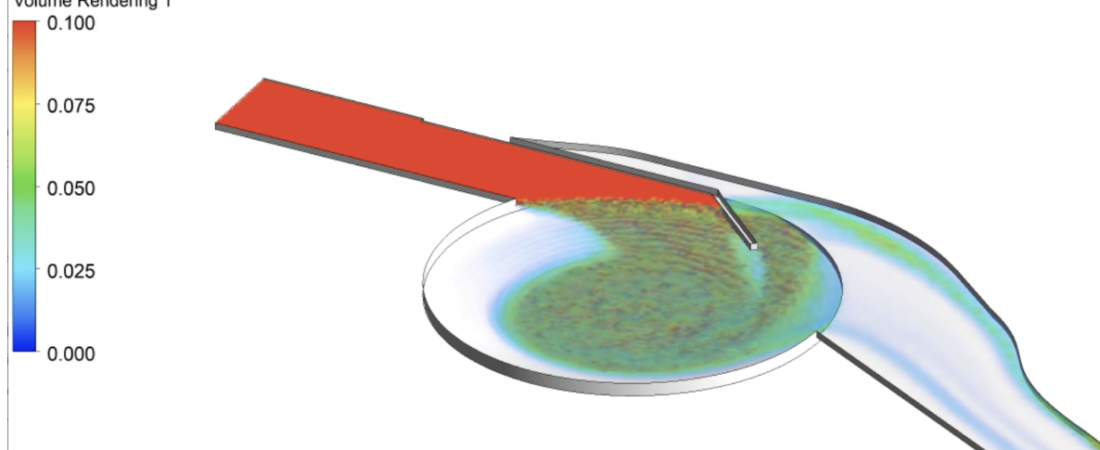
Sediment traps are critical infrastructure used in water treatment plants, hydropower facilities, and mining operations to remove suspended solids from water before it enters downstream systems. These basins rely heavily on gravity to settle particles out of the flow. However, traditional design methods often rely on simplified, empirical formulas that fail to capture the complex, real-world fluid behavior inside the basin. Computational Fluid Dynamics (CFD) provides engineers with a digital laboratory to visualize, analyze, and optimize sediment trap performance with high precision.
Technical and Theoretical Description
From a physics standpoint, a sediment trap operates on multi-phase fluid dynamics, primarily involving a continuous phase (water) and a discrete phase (sediment particles). To simulate this environment accurately, CFD applications employ the Navier-Stokes equations to solve the flow field. Because water entering a sediment trap is almost always turbulent, designers use turbulence models—most commonly the Reynolds-Averaged Navier-Stokes (RANS) formulations, such as the standard k-ε or k-ω SST models—to capture the turbulent kinetic energy and dissipation rates that influence particle suspension.
Once the primary fluid flow is established, particle tracking is simulated using one of two main approaches. The Eulerian-Eulerian model treats both water and sediment as interpenetrating continua, which is ideal for high-sediment concentrations. Alternatively, the Eulerian-Lagrangian approach tracks individual sediment particles or clusters as they move through the continuous water phase. This method applies Newton’s second law to each particle, calculating the balance of forces including gravity, buoyancy, and hydrodynamic drag. The core theoretical metric evaluated is the trap efficiency (η), defined as the ratio of mass flow rate of sediment retained in the basin to the mass flow rate entering the system. CFD allows engineers to map out dead zones, short-circuiting paths, and shear stress profiles along the basin floor, ensuring that settled particles are not re-entrained back into the current.
Business Value of CFD Implementation
From a commercial perspective, deploying CFD in sediment trap design yields substantial cost savings and risk mitigation throughout the project lifecycle. In the asset design phase, it replaces expensive physical scale modeling, shortening the engineering timeline and reducing overall R&D expenditures. By identifying design flaws virtually, companies avoid the catastrophic capital expenditure of altering physical concrete structures post-construction.
In terms of operational expenditures (OpEx), an optimized sediment trap drastically reduces downstream equipment wear. In hydropower setups, uncaught abrasive sediment causes rapid turbine runner erosion, leading to frequent shutdowns, expensive component replacement, and lost revenue from power generation. For municipal water works, maximizing sediment trap efficiency relieves the load on downstream filtration units, lowering the consumption of chemical coagulants and extending backwash cycles. Ultimately, CFD transforms a sediment trap from a conservative, over-designed footprint into a highly efficient, right-sized asset that maximizes return on investment.
Challenges of CFD in Sediment Basin Modeling
Despite its power, simulating a sediment trap introduces specific physical and computational challenges. The primary obstacle is accurately modeling particle-fluid interactions under varying environmental conditions. Sediments are rarely uniform spheres; they possess highly irregular shapes and a wide distribution of sizes, which directly impacts their drag coefficients and settling velocities.
Additionally, high-concentration sediment plumes alter the viscosity and density of the surrounding water—a phenomenon known as two-way or four-way phase coupling. Capturing these interactions requires immense computational power and fine mesh sizing, particularly near the basin bed where sediment accumulates. Modeling the exact threshold of re-entrainment—where high turbulent shear stresses pick settled particles back up off the floor—remains a highly complex boundary layer problem that can distort efficiency predictions if poorly configured.
Solutions for High-Fidelity Simulation
To overcome these challenges, modern simulation workflows utilize a combination of specialized physical sub-models and advanced meshing strategies. Engineers mitigate the non-spherical particle problem by implementing custom drag laws (such as the Haider and Levenspiel correlation) that factor in particle sphericity. To accurately capture the wide variance in sediment composition, the discrete phase is categorized into a multi-class size distribution rather than a single average diameter.
To balance computational efficiency with accuracy, a transient simulation approach is paired with dynamic mesh adaptation or dense boundary layer cell inflation near the bottom floor. This ensures the localized fluid shear stresses are computed precisely. Furthermore, implementing empirical re-entrainment criteria, such as the Shields parameter or critical shear stress thresholds at the lower boundary, allows the simulation to realistically predict whether settled material will stay on the floor or wash away during high-flow storm events. These solutions ensure the virtual model matches field performance.
Author: Caesar Wiratama
Find me on Linkedin