
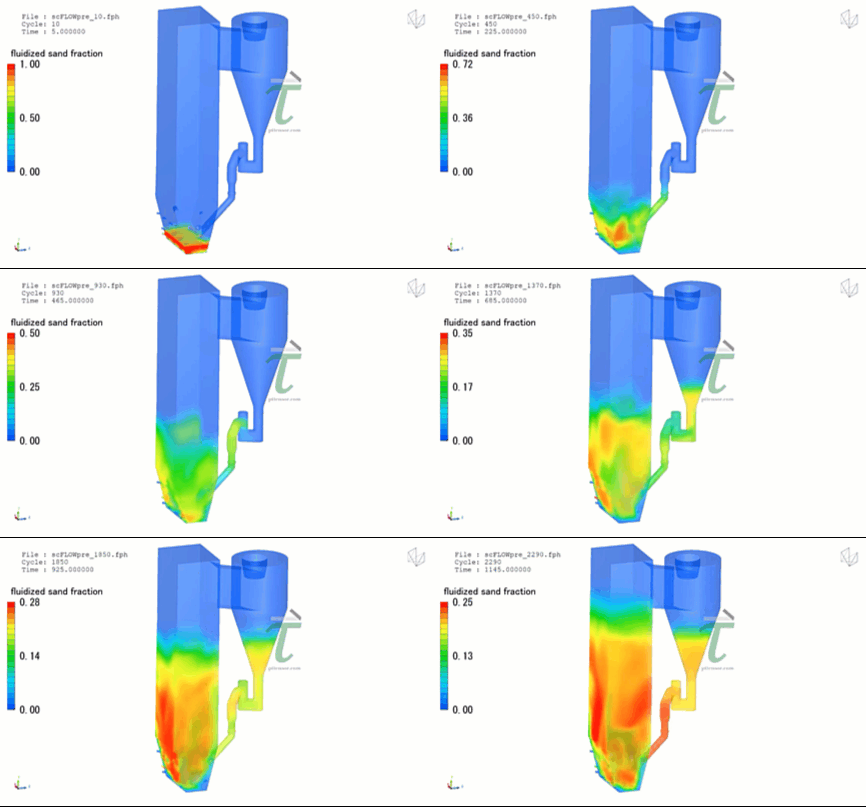
Fluidized bed boilers are highly efficient, flexible thermal assets widely utilized in power generation and industrial processing due to their unique ability to burn low-grade, highly variable fuels—such as biomass, waste-derived fuels, and high-sulfur coal—at relatively low combustion temperatures. By suspending solid fuel particles in a upward-flowing stream of air, these boilers achieve exceptional mixing and heat transfer rates. However, managing the chaotic hydrodynamics within the bed is a complex engineering task. Computational Fluid Dynamics (CFD) provides engineers with a sophisticated virtual laboratory to analyze dense gas-solid interactions, evaluate chemical reactions, and optimize boiler geometries with extreme precision.
Technical and Theoretical Description
From a physical and chemical perspective, a fluidized bed boiler operates on dense multiphase reacting flow dynamics governed by the three-dimensional, compressible Navier-Stokes equations coupled with granular kinetic theory and species transport equations. Fluidized bed boilers generally fall into two categories: Bubbling Fluidized Beds (BFB) and Circulating Fluidized Beds (CFB), both of which feature a dense bed of sand, fuel, and sorbent material. To simulate this highly turbulent, mass-dense environment, CFD applications deploy advanced multiphase modeling approaches. The Eulerian-Eulerian (Two-Fluid Model) treats both the gas and solid phases as interpenetrating continua, utilizing the kinetic theory of granular flow to compute solid pressures and viscosities. Alternatively, the Eulerian-Lagrangian Dense Discrete Phase Model (DDPM) or Multiphase Particle-in-Cell (MPIC) approach tracks discrete particle clusters while accounting for high-volume fraction particle-to-particle collisions.
The combustion process relies on a coupled transient framework that mirrors the progression of solid fuel through the fluidized medium:
- Fluidization Hydrodynamics: The upward gas velocity must exceed the minimum fluidization velocity, creating a regime where the solid bed behaves like a boiling liquid.
- Thermal Devolatilization and Gasification: Solid fuel particles absorb intense thermal energy from the hot bed material, rapidly releasing volatile gases.
- Homogeneous and Heterogeneous Reactions: Volatile gases burn in the gas phase (homogeneous), while remaining solid char oxidizes on the particle surfaces (heterogeneous).
- In-Situ Sulfur Capture: Sorbent materials like limestone (CaCO₃) calcine and react directly with sulfur dioxide (SO₂) within the bed to form calcium sulfate, neutralizing emissions before they leave the furnace.
Because these boilers operate at a controlled temperature range (typically 800 to 900 degrees Celsius), thermal NOx formation is inherently minimized. However, capturing the true heat transfer profile requires high-fidelity radiation models, such as the Discrete Ordinates (DO) model, configured to account for the highly scattering nature of the dense particulate bed.
Business Value of CFD Implementation
From a commercial standpoint, deploying CFD to analyze and optimize fluidized bed boilers yields substantial capital expenditure (CapEx) savings and heavily reduces plant operational expenditures (OpEx). During the design phase or fuel conversion retrofits, CFD acts as a risk-free virtual prototyping environment. Engineers can simulate changes to fuel feed placements, secondary air injector layouts, and cyclone separators in software, compressing project timelines and avoiding the extreme financial risks of modifying massive physical steel and refractory structures.
In terms of OpEx, CFD optimization directly drives fuel flexibility and lowers maintenance costs. Fluidized bed operators can safely test the combustion behavior of high-moisture biomass or corrosive waste fuels digitally, discovering the exact operational parameters required to maintain steam output without causing mechanical harm. Furthermore, optimization prevents severe localized erosion on water-wall tubes and heat exchangers caused by high-velocity sand particle impacts. By adjusting airflow distribution through CFD to eliminate these erosion hotspots, plants reduce unscheduled forced outages and extend the operational lifespan of the boiler pressure parts, maximizing overall return on investment.
Challenges of CFD in Fluidized Bed Modeling
Despite its analytical power, simulating a fluidized bed boiler introduces massive numerical and physical challenges. The primary obstacle is the dense multiphase coupling and the vast spectrum of spatial and temporal scales. The simulation must capture the macroscopic flow inside a boiler tower stretching dozens of meters, while simultaneously resolving sub-millimeter gas bubbles, particle collisions, and rapid chemical reaction kinetics occurring at microsecond intervals.
Another major hurdle is accurately modeling the high-volume fraction momentum exchange (drag laws) between the gas and solid phases. Standard drag models often fail in dense fluidization regimes because particles tend to form temporary clusters or structures, which drastically alters the actual drag force compared to isolated spheres. Over-simplifying these drag characteristics or the granular restitution coefficients leads to incorrect predictions of bed expansion, unrealistic particle carryover into the cyclone, and highly skewed temperature fields that invalidate emissions and heat transfer calculations.
Solutions for High-Fidelity Simulation
To overcome these dense multiphase and computational scale challenges, modern boiler engineering workflows leverage advanced sub-grid physical models and optimized meshing techniques. Engineers resolve the drag discrepancies by implementing structure-dependent drag laws, such as the Energy-Minimization Multi-Scale (EMMS) model, which dynamically adjusts momentum exchange coefficients based on localized particle clustering behavior. Solid fuels are modeled using multi-component discrete distributions to accurately reflect the wide variance in density and size between the heavy bed sand, reactive limestone, and porous fuel particles.
To manage the massive computational load of tracking billions of individual particles, workflows utilize advanced MPIC or DDPM formulations that group physical particles into statistical “computational parcels.” Computational domains are constructed using high-quality hexahedral or polyhedral grids, with heavy grid refinement applied at the air distributor nozzles and the splash zone just above the dense bed. Finally, localized erosion risks on the boiler walls are quantitatively mapped by extracting particle impact angles and velocities from the CFD solver and feeding them into empirical material wear equations. This comprehensive workflow enables structural and thermal engineers to finalize a balanced, highly durable boiler configuration before manufacturing begins.
Author: Caesar Wiratama
Find me on Linkedin