
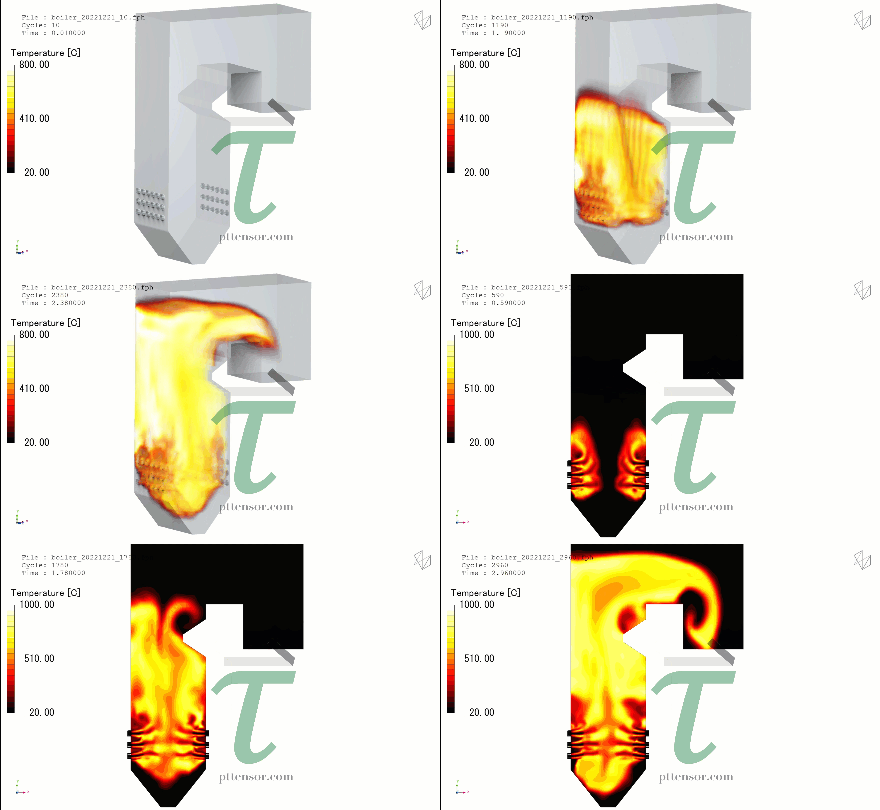
Coal-fired boilers are massive, complex thermal assets that form the backbone of baseload power generation and heavy industrial steam production. Achieving optimal combustion within these systems is a balancing act: operators must maximize fuel burnout and thermal efficiency while strictly minimizing the formation of harmful emissions like nitrogen oxides (NOx) and carbon monoxide (CO). Traditional empirical tuning and physical probing are highly restricted due to the extreme, hazardous internal environments of the furnace. Computational Fluid Dynamics (CFD) provides combustion engineers with a non-destructive digital furnace to visualize multi-phase reactions, evaluate localized gas temperatures, and optimize firing configurations with extreme precision.
Technical and Theoretical Description
From a physics and chemistry perspective, coal combustion analysis operates on highly coupled, transient, multi-phase reacting fluid dynamics governed by the three-dimensional, compressible Navier-Stokes, energy, and chemical species transport equations. The system handles a continuous phase (turbulent flue gas) and a discrete phase (pulverized coal particles). To capture the intense swirling and mixing of air and fuel within the burners, CFD simulations utilize advanced turbulence models, most commonly the Reynolds-Averaged Navier-Stokes (RANS) Realizable k-epsilon or Shear Stress Transport (k-omega SST) models.
The transformation of solid coal into thermal energy is solved using a sequential multi-step chemical reaction framework through Eulerian-Lagrangian particle tracking:
- Moisture Evaporation: Rapid thermal drying as coal particles enter the hot furnace zone.
- Devolatilization: The thermal decomposition of solid coal into volatile gases and solid char, typically modeled via the Kobayashi dual-rate or single-rate Arrhenius kinetics.
- Volatile Combustion: Gas-phase reactions where volatile species mix with oxygen. This is governed by turbulence-chemistry interaction models like the Eddy Dissipation Concept (EDC) or Finite-Rate/Eddy-Dissipation model, solving species transport for carbon dioxide, water vapor, carbon monoxide, and intermediate hydrocarbons.
- Char Oxidation: The heterogeneous combustion of the remaining solid carbon matrix, modeled via diffusion-kinetic mechanisms where oxygen diffuses to the particle surface to burn the solid core.
Thermal radiation, which accounts for over 90% of the heat transfer inside the furnace, is computed using high-fidelity models such as the Discrete Ordinates (DO) or P-1 radiation models, factoring in gas and particle absorption coefficients. Concurrently, thermal and prompt NOx formation kinetics are solved using decoupled post-processing or coupled transport equations based on the extended Zeldovich mechanism and fuel-bound nitrogen pathways.
Business Value of CFD Implementation
From a commercial perspective, deploying CFD for coal combustion optimization yields massive capital expenditure (CapEx) savings and directly drives down plant operational expenditures (OpEx). During a low-NOx burner retrofit or boiler modernization project, CFD serves as a rapid virtual prototyping environment. Engineers can evaluate dozens of overfire air (OFA) injector angles, burner tilt positions, and coal-to-air ratios in software, drastically compressing project engineering timelines and avoiding the catastrophic costs of physical structural trial-and-error.
In terms of OpEx, an optimized combustion profile directly maximizes boiler efficiency and fuel economy. Minimizing unburned carbon in fly ash (known as Loss on Ignition or LOI) ensures that the plant extracts every megawatt of thermal energy possible from the coal supply, yielding millions of dollars in annual fuel savings. Furthermore, tuning the combustion profile via CFD to reduce localized peak flame temperatures significantly limits raw NOx formation. This lowers the operational consumption of expensive chemical reagents (such as ammonia or urea) used in downstream Selective Catalytic Reduction (SCR) systems, delivering massive compliance-related savings while satisfying strict environmental regulations.
Challenges of CFD in Combustion Modeling
Despite its analytical power, simulating coal combustion introduces some of the steepest numerical and physical challenges in the entire field of engineering. The foremost obstacle is the massive scale discrepancy coupled with extreme mathematical non-linearity. A utility boiler can stand over 50 meters tall, yet the simulation must simultaneously resolve the millimeter-scale boundary layer physics at the burner nozzles and the micron-scale chemical reaction zones on individual pulverized coal particles.
Another major hurdle is the deep coupling and stiffness of the governing equations. A small change in localized turbulence alters the volatile mixing rate, which exponentially skews temperature fields due to the Arrhenius dependence of chemical kinetics, which in turn radically distorts radiative heat transfer and NOx predictions. Furthermore, modeling physical degradation mechanisms like ash slagging and wall fouling—where molten ash particles deposit, solidify, and form insulating layers on water-wall tubes—requires complex tracking of particle melting points and viscosity thresholds, making it highly prone to numerical divergence if the boundary meshes or time steps are poorly managed.
Solutions for High-Fidelity Simulation
To overcome these multi-phase and reacting flow challenges, modern combustion engineering workflows combine advanced numerical strategies with tightly integrated solver physics. Engineers resolve scale discrepancies by utilizing non-uniform, polyhedral, or hex-dominant meshing, applying extreme grid refinement around the burner zones and utilizing automated Adaptive Mesh Refinement (AMR) in regions experiencing steep temperature and chemical species gradients. Pulverized coal distributions are modeled using a multi-component discrete phase method, where fuel particles are categorized into realistic statistical size bins based on actual sieve data rather than assuming a single average diameter.
To stabilize the stiff chemical reaction equations, simulations often utilize a step-by-step solver approach. A cold flow field is established first, followed by a non-reacting thermal flow, before finally activating the volitilization, gas-phase, and heterogeneous char combustion reactions with tight under-relaxation factors. Slagging risks are successfully mapped by integrating custom user-defined functions (UDFs) that evaluate the thermal and kinetic state of ash particles upon wall impact against the empirical ash fusion temperatures of the specific coal blend. Finally, the extracted radiative and convective heat flux profiles are mapped onto the boiler’s steam-side water-wall network. This ensures that structural engineers can verify safe, uniform heat absorption profiles and eliminate localized tube-overheating hotspots before the physical boiler fires up.
Author: Caesar Wiratama
Find me on Linkedin