
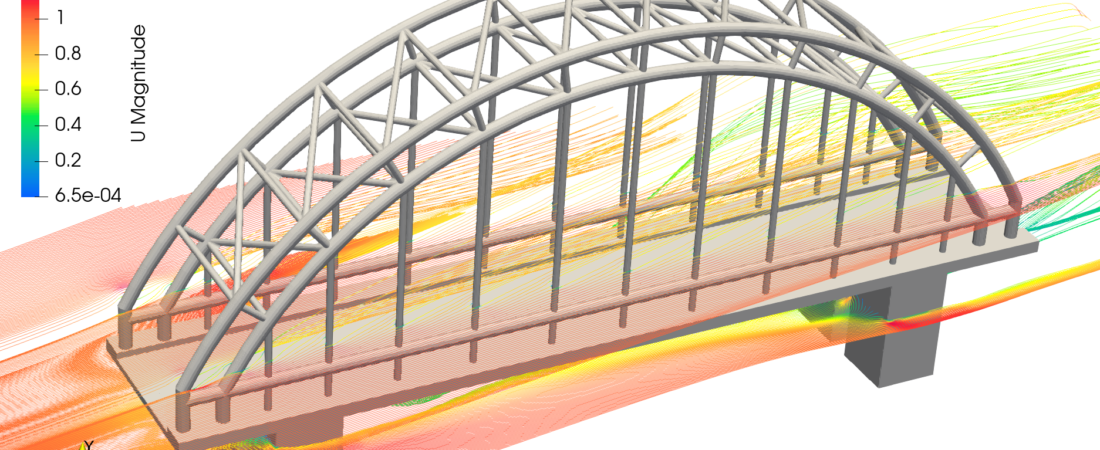
Long-span bridges, such as suspension and cable-stayed structures, are highly flexible engineering assets that are exceptionally vulnerable to wind-induced forces. Because wind interactions can cause severe structural fatigue, traffic disruptions, or catastrophic aeroelastic collapse, validating a bridge’s aerodynamic performance is a fundamental safety requirement. Historically, this relied exclusively on expensive boundary-layer wind tunnel testing of physical scale models. Computational Fluid Dynamics (CFD) provides structural engineers with a high-fidelity virtual wind tunnel to visualize complex flow fields, evaluate aerodynamic forces, and optimize deck geometries with extreme precision.
Technical and Theoretical Description
From a fluid mechanics perspective, bridge aerodynamics involves complex external fluid-structure interactions characterized by high Reynolds number flows, massive flow separation, and vortex shedding. The flow field around a bridge deck is governed by the three-dimensional Navier-Stokes equations. Because wind interacting with a blunt structural body generates intense turbulence and organized wake structures, steady-state simulations are insufficient. Engineers utilize advanced transient turbulence closures, most notably Scale-Adaptive Simulations (SAS) or Detached Eddy Simulations (DES), which apply high-fidelity Large Eddy Simulation (LES) in the turbulent wake while using Reynolds-Averaged Navier-Stokes (RANS) models near the solid boundaries to optimize computational cost.
The primary theoretical focus in bridge aerodynamics is evaluating the bridge deck’s aerodynamic derivatives and identifying aeroelastic phenomena such as vortex-induced vibrations (VIV), galloping, and aerodynamic flutter. Flutter is a highly dangerous, self-excited aeroelastic phenomenon where aerodynamic forces couple with the structural modal frequencies, leading to divergent, destructive oscillations. CFD captures this by computing the time-varying lift (CL), drag (CD), and pitching moment (CM) coefficients as a function of the wind’s angle of attack. By extracting these force history profiles, engineers can mathematically map the pressure distributions across the deck to ensure the cross-section remains aerodynamically stable under extreme gale-force winds.
Business Value of CFD Implementation
From a commercial standpoint, deploying CFD in bridge engineering yields massive capital expenditure (CapEx) savings and substantially compresses project delivery timelines. Physical wind tunnel testing requires manufacturing highly detailed, precise scale models and booking specialized laboratory space, costing hundreds of thousands of dollars per testing phase. CFD serves as a rapid virtual prototyping tool, allowing design teams to test dozens of cross-sectional iterations—adjusting edge fairings, soffit plates, and central slot widths—in a fraction of the time and cost.
In terms of operational value, an aerodynamically optimized bridge deck design vastly reduces long-term maintenance expenditures and ensures high structural reliability. Minimizing vortex-induced vibrations prevents localized cyclic stress on stay cables, hangers, and steel welds, mitigating the risk of premature structural fatigue failure. Furthermore, CFD allows engineers to accurately evaluate wind barriers and baffling systems that protect vehicles from intense crosswinds. By optimizing these barriers to maintain vehicular stability without compromising the deck’s overall aerodynamic performance, bridge authorities can safely avoid costly traffic closures during high-wind events, maximizing the asset’s economic utility.
Challenges of CFD in Bridge Aeroelastic Modeling
Despite its analytical strengths, simulating bridge aerodynamics introduces steep multi-scale physical and numerical challenges. The foremost obstacle is capturing the massive scale discrepancies within the computational domain. The simulation must model a massive atmospheric flow field extending hundreds of meters around the bridge to capture realistic wind profiles, yet it must simultaneously resolve millimeter-scale boundary layers, vortex-shedding shear layers, and small structural details like handrails or traffic barriers that heavily influence local flow separation.
Another major hurdle is accurately modeling true fluid-structure interaction (FSI) for moving bodies. For phenomena like flutter or VIV, the bridge deck is not static; its motion changes the surrounding flow field, which in turn alters the structural forces. Simulating this requires fully coupled, two-way FSI solvers where the CFD fluid pressure fields deform the structural mesh via Finite Element Analysis (FEA), and the resulting structural displacements move the CFD boundaries. Managing this dynamic mesh deformation without compromising cell quality or triggering severe numerical instabilities demands highly sophisticated algorithms and immense computational power.
Solutions for High-Fidelity Simulation
To overcome these multi-scale and aeroelastic challenges, modern bridge engineering workflows utilize advanced spatial discretization and tightly coupled solver frameworks. Engineers resolve the scale discrepancy by utilizing multi-zone meshing strategies paired with unstructured overset (chimera) grids or automated Adaptive Mesh Refinement (AMR). This allows for a highly dense grid surrounding the deck profile and its immediate wake to capture shedding frequencies (Strouhal number precision), while maintaining a computationally efficient, coarser mesh in the far-field domain. Small geometric features like barriers are often parameterized using directional aerodynamic loss coefficients if resolving their full geometry proves computationally prohibitive.
To simulate dynamic aeroelastic motions safely and accurately, engineers utilize Arbitrary Lagrangian-Eulerian (ALE) formulations or overset meshing to handle deck displacement and rotation smoothly. For two-way FSI simulations, the transient fluid solver is tightly coupled with a structural modal solver, synchronizing at sub-time-step intervals to track real-time deck oscillations. Finally, to eliminate aerodynamic instabilities, engineers use the CFD environment to virtually iterate aerodynamic counter-measures. This includes testing the addition of guide vanes, tuned mass dampers, or porous wind screens. Validating the efficacy of these geometric modifications in software guarantees that the final bridge blueprint achieves absolute aerodynamic stability prior to physical construction.
Author: Caesar Wiratama
Find me on Linkedin