
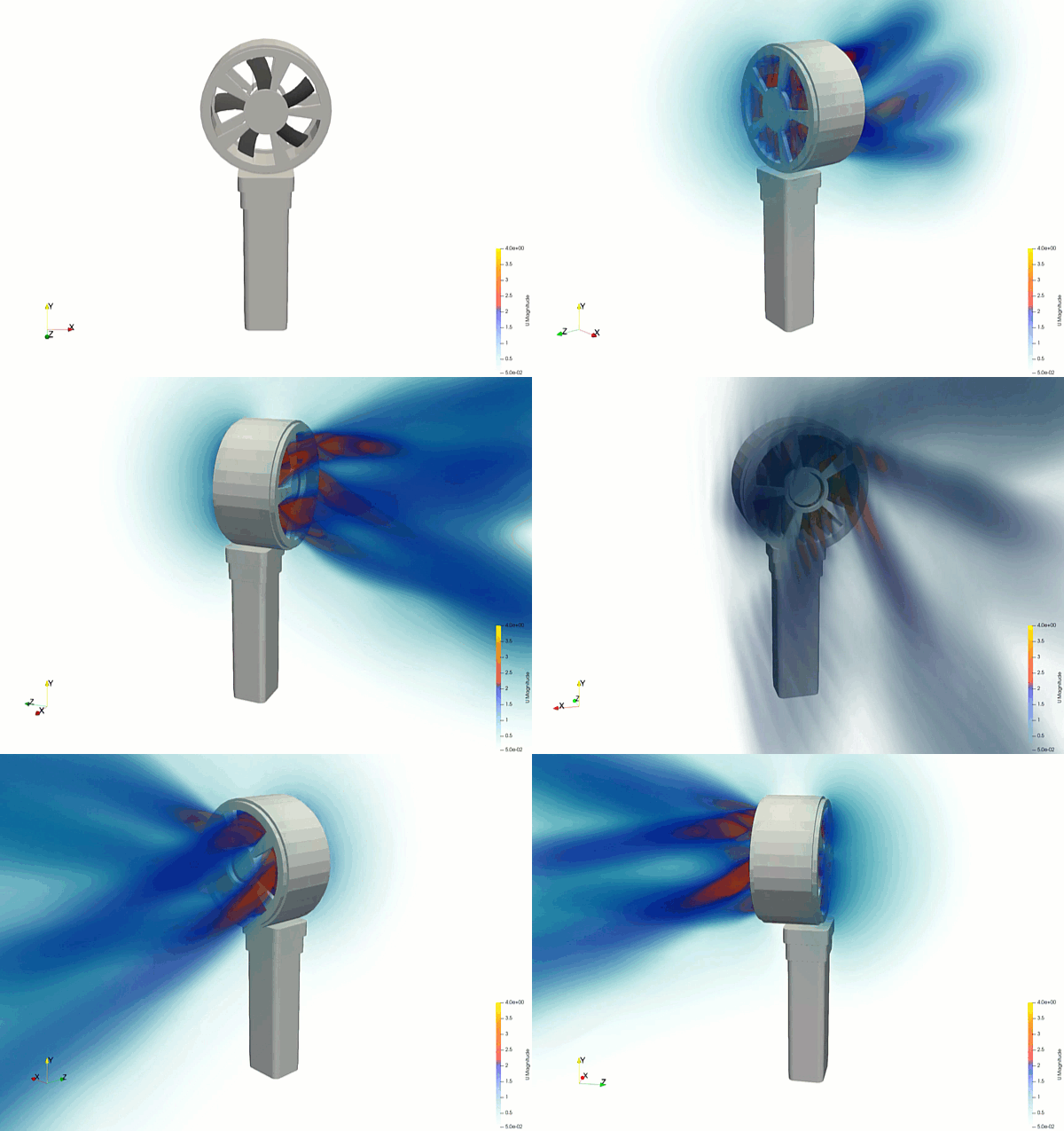
A portable, handheld fan has one primary job: to deliver a refreshing breeze while consuming as little battery power as possible. To a consumer, a fan is a simple plastic device. To an engineer, it is a complex aerodynamic challenge where blade geometry, rotational speed, and housing design must align perfectly. For a startup with limited capital, guessing the right blade shape through physical prototyping is a massive financial risk. This is where Computational Fluid Dynamics (CFD) becomes an indispensable tool, allowing entrepreneurs to visualize, analyze, and perfect fluid flow entirely in a virtual environment.
Visualizing the Invisible: The Core of Fluid Simulation
Air is invisible, which makes traditional aerodynamic testing notoriously difficult. In the past, engineers had to build physical models and place them in wind tunnels with smoke generators to catch a fleeting glimpse of how air moved around a product. CFD changes this entirely by transforming the digital CAD model of the handheld fan into a virtual laboratory.
By dividing the air space inside and around the fan into millions of tiny computational cells, CFD software solves the fundamental equations of fluid mechanics. For a startup, this unlocks high-resolution, color-coded visual maps of airflow velocity, pressure distribution, and vector fields. Designers can see exactly how air enters the rear grille, how it accelerates across the blades, and how it projects outward toward the user.
Eliminating Turbulence and Aeroacoustic Noise
One of the biggest differentiators in the premium consumer electronics market is noise. A portable fan that sounds like a miniature jet engine will quickly receive poor user reviews. Much of this unwanted noise is caused by turbulence—areas where air separates from the blade surface or collides harshly with the protective outer grille.
Using CFD, a startup can pinpoint these high-turbulence zones with extreme precision. The simulation might reveal that the air is stalling at the tips of the blades, creating micro-vortices that generate a high-pitched whine. Armed with this visual data, engineers can subtly twist the blade profile, alter the wingtip geometry, or optimize the spacing between the blades and the outer shroud. By smoothing out the airflow virtually, the startup can engineer a whisper-quiet product before ever manufacturing a single physical component.
Balancing Aerodynamic Efficiency and Battery Constraints
In handheld devices, every milliampere-hour of battery capacity matters. A poorly designed fan blade creates excessive aerodynamic drag, forcing the electric motor to draw more current and rapidly draining the battery. Conversely, a blade designed with too little resistance might not push enough air to keep the user cool.
CFD enables startups to run automated optimization loops to find the perfect middle ground. Engineers can virtually test dozens of design variations in a matter of days—varying the number of blades, adjusting the pitch angle, and experimenting with curved profiles. The software calculates the exact torque required to spin each variation alongside the resulting volumetric flow rate. This allows the startup to maximize the fan’s cubic feet per minute (CFM) output while minimizing the motor’s power consumption, directly resulting in a product that blows stronger and lasts longer on a single charge.
Streamlining the Housing and Grille Design
The design of a portable fan does not stop at the blades; the protective housing and finger-guard grilles play a massive role in overall performance. A front grille with ribs that are too thick or angled incorrectly will act as a barrier, blocking the airflow and pushing it sideways rather than forward.
Through CFD, a startup can analyze the interaction between the spinning air exiting the blades and the stationary ribs of the grille. Engineers can shape the grille ribs to act as stators—stationary vanes that straighten the twisting airflow into a focused, long-reaching column of air. This optimizes the effective cooling distance of the fan, ensuring that the user feels a tight, refreshing breeze even when holding the device at arm’s length. By leveraging CFD from the blades to the enclosure, a startup transforms a basic commodity into a highly engineered, premium consumer product.
Author: Caesar Wiratama
Find me on Linkedin