
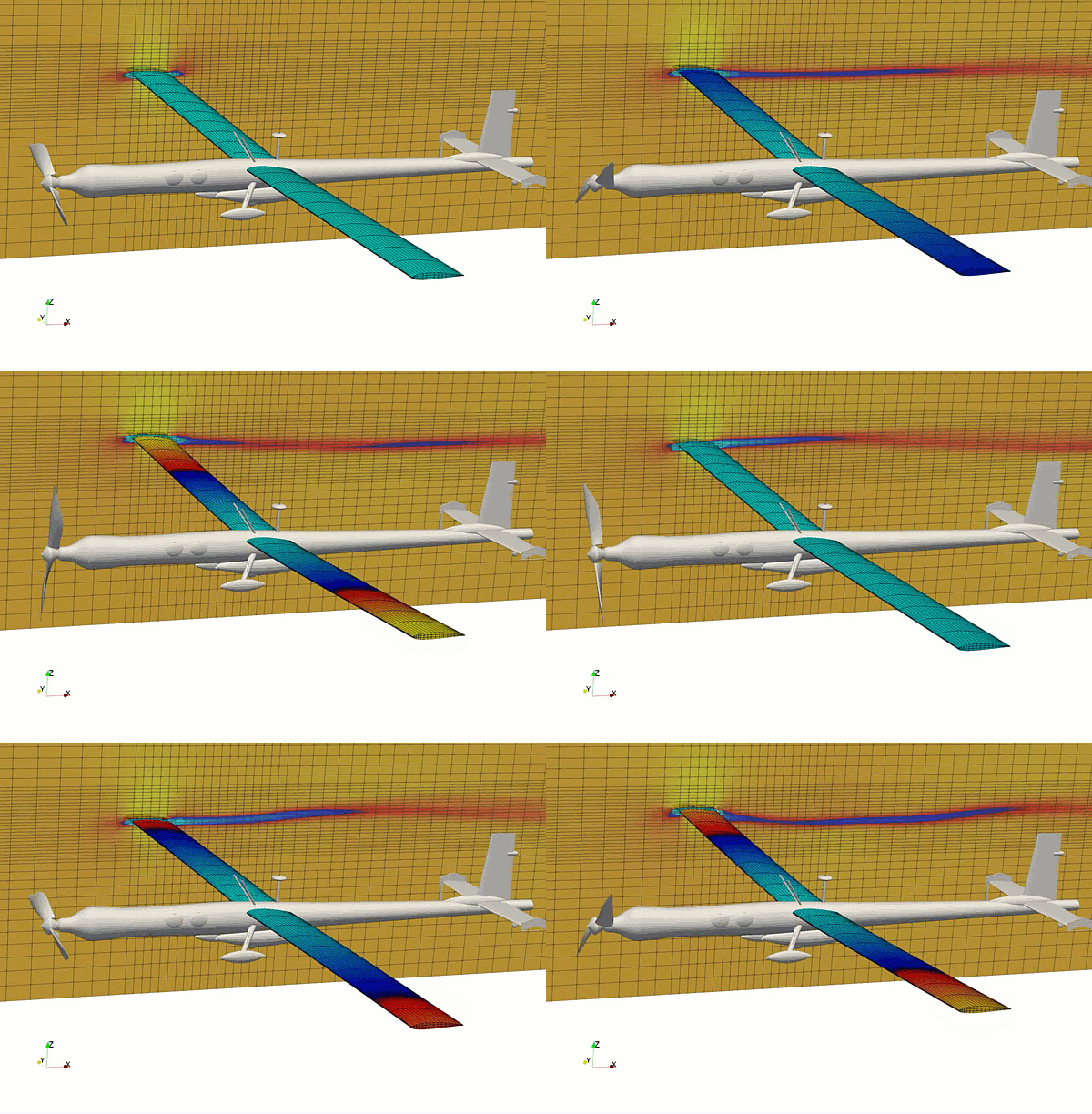
In the rapidly evolving aerospace market, hardware startups face intense pressure to deliver high-performance aircraft while managing limited capital and tight timelines. For companies developing fixed-wing Unmanned Aerial Vehicles (UAVs) with high aspect ratio wings—designed for long-endurance surveillance, precision agriculture, or cargo delivery—traditional design cycles can be a massive bottleneck. Relying solely on physical prototyping and wind tunnel testing introduces high costs and late-stage design failures. To stay competitive, forward-thinking startups are optimizing their business and engineering workflows by embedding Fluid-Structure Interaction (FSI) simulation directly into their product development pipeline.
Overcoming the Structural Vulnerability of High Aspect Ratio Wings
High aspect ratio wings offer excellent aerodynamic efficiency and extended range, but their long, slender profiles make them highly susceptible to significant structural deformation under aerodynamic loads. When air flows over these flexible structures, the wings bend and twist, altering the aerodynamic forces acting upon them. This creates a complex feedback loop where fluid dynamics and structural mechanics constantly influence each other. Standard, rigid-body aerodynamic modeling fails to capture these variations, leaving engineering teams blind to critical phenomena like aeroelastic flutter, control surface reversal, or catastrophic structural failure. FSI simulation solves this by bridging the gap, allowing startups to analyze how structural bending changes aerodynamic performance in real time.
Accelerating Time to Market by Reducing Physical Prototyping
One of the greatest operational benefits of adopting FSI simulation is the drastic compression of the product development lifecycle. Traditionally, building physical scale models, scheduling wind tunnel time, and conducting flight tests take months and cost tens of thousands of dollars per iteration. If a wing undergoes unexpected flutter during a physical test, the team must return to the drawing board, destroying both the budget and the timeline. By moving this validation process into a virtual environment, a startup can test dozens of wing geometries, composite layups, and structural spars within days. Discovering design flaws digitally before manufacturing a single component ensures that the first physical prototype built is already highly optimized for flight.
Optimizing Material Efficiency and Payload Capacity
For long-endurance UAVs, every gram of weight matters. Startups must balance the need for a lightweight structure to maximize battery or fuel life with the stiffness required to survive turbulent air. FSI simulation gives engineers the precise data needed to perform advanced topology optimization and composite material tailoring. Instead of over-engineering the wing with heavy internal supports out of caution, design teams can use simulation insights to place material only where the stress dictates. This targeted structural reinforcement minimizes weight, improves manufacturing material costs, and directly translates to increased payload capacity or extended flight range for the end customer.
Shifting Left to Mitigate Financial and Technical Risk
In business process management, “shifting left” refers to moving testing, quality assurance, and risk assessment to the earliest possible stages of development. FSI simulation serves as the ultimate risk mitigation tool for aerospace startups. By identifying non-linear aeroelastic behaviors, fatigue hot spots, and structural limits early in the conceptual or preliminary design phases, companies avoid the devastating financial blow of late-stage engineering changes. This predictive capability gives investors and stakeholders higher confidence in the startup’s technical roadmap, as major design risks are mathematically and computationally mitigated before moving toward commercialization.
Driving Business Scalability Through Digital Workflows
Ultimately, integrating FSI simulation transforms a hardware startup from a reactive engineering shop into an agile, data-driven enterprise. The digital models built during the FSI process establish a foundational “digital twin” of the UAV. This virtual asset can be continuously updated with real flight telemetry data to improve future aircraft iterations, streamline maintenance schedules, and customize existing platform designs for bespoke client requirements. By replacing slow, physical trial-and-error with high-fidelity digital workflows, startups can scale their product offerings faster, minimize overhead, and capture market share in a highly demanding industry.
Author: Caesar Wiratama
Find me on Linkedin