
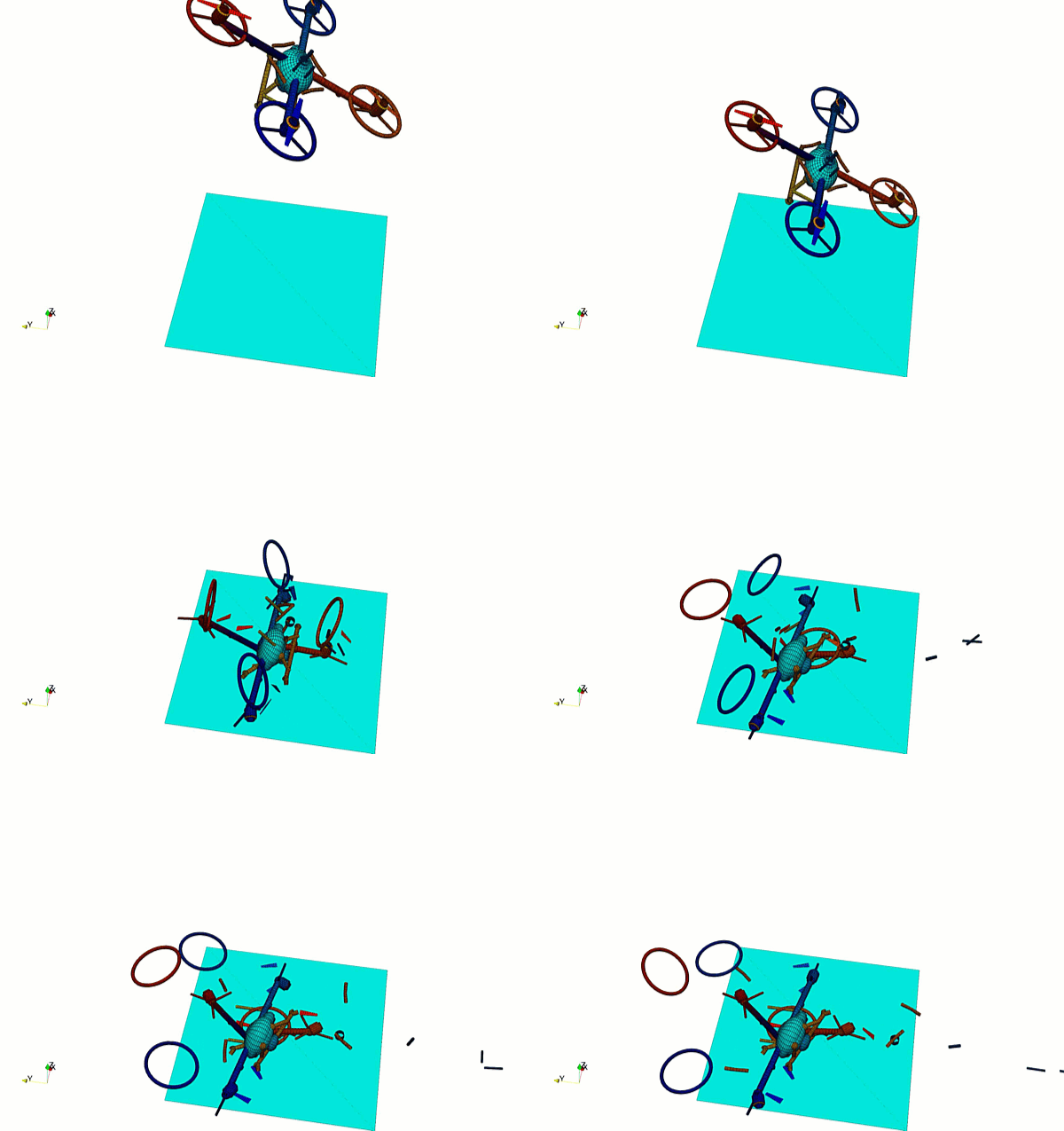
The commercial and consumer drone markets are growing at a rapid pace, putting intense pressure on manufacturers to deliver durable, lightweight, and reliable aircraft. One of the most critical phases in drone development is ensuring structural integrity during crashes or hard landings. Traditionally, companies relied on physical drop testing, a method that is slow, expensive, and destructive. Today, forward-thinking engineering teams use Finite Element Analysis (FEA) to simulate drone drop tests digitally, transforming product development from a costly guessing game into a streamlined, data-driven science.
Drastically Reducing Prototyping Costs
Physical prototyping is one of the largest financial drains in hardware development. Building a functional quadcopter prototype requires expensive materials, precision machining, and specialized labor. When a physical drone is dropped from a specific height to test its impact resistance, the result is often a pile of shattered carbon fiber and broken electronics. Engineers must then diagnose the failure, modify the design, and build an entirely new prototype for the next test. FEA simulation breaks this destructive cycle. By creating a digital twin of the drone, engineers can simulate hundreds of drop scenarios from various heights, angles, and surface types without destroying a single piece of hardware. This optimization saves businesses thousands of dollars in material and manufacturing costs before the first physical build even begins.
Accelerating Time-to-Market
In competitive technology sectors, being first to market provides a massive strategic advantage. Physical testing creates a logistical bottleneck because ordering materials, machining parts, assembling electronics, and setting up testing rigs takes weeks or months. If a design fails a physical drop test late in the development cycle, the launch timeline suffers severe delays. FEA simulation compresses these timelines dramatically. A virtual drop test can be set up, run, and analyzed in a matter of hours or days. Design iterations happen entirely in software, allowing engineering teams to identify weak points, modify geometry, and re-test immediately. This rapid feedback loop allows companies to finalize their designs months ahead of schedule, capturing market share before competitors can catch up.
Optimizing the Balance Between Weight and Strength
Quadcopter design is a delicate balancing act between structural strength and flight efficiency. A drone must be rugged enough to survive rough landings, yet light enough to maximize battery life and payload capacity. Over-engineering a drone by making its frame thicker makes it durable, but the added weight degrades flight performance. FEA simulation provides engineers with precise, visual data on stress distribution, material deformation, and energy absorption during an impact. This granular insight allows designers to remove unnecessary material from low-stress areas and reinforce high-stress zones. The result is a highly optimized, lightweight structure that achieves peak flight efficiency without sacrificing crash durability.
Minimizing Post-Launch Warranty Claims and Recalls
Product failures that occur after a drone has hit the market are catastrophic for a business, leading to expensive warranty claims, product recalls, and severe damage to brand reputation. Physical drop testing can only cover a limited number of variables due to time and budget constraints. FEA simulation allows engineers to test worst-case scenarios and edge cases that would be too difficult or costly to replicate in a physical lab, such as impacting at highly specific oblique angles or striking varied terrain like concrete or soil. By uncovering hidden vulnerabilities during the digital design phase, companies can ensure a rugged final product, drastically lowering failure rates in the hands of consumers and protecting the company’s bottom line.
Author: Caesar Wiratama
Find me on Linkedin