
Building a physical product is a notoriously difficult journey. Hardware startups face a steep uphill battle compared to software companies, primarily because physical development requires significant upfront capital for tooling, materials, and manufacturing. When approaching venture capitalists and angel investors, hardware founders often meet skepticism regarding high costs and long development timelines. This is where Computer-Aided Engineering (CAE) and simulation tools become a startup’s secret weapon. By using advanced virtual testing, founders can transform their pitches from speculative ideas into highly calculated, de-risked business opportunities.
Proving Feasibility Before Buying a Single Part
Investors are inherently risk-averse, and their biggest fear with a hardware startup is that the product simply will not work as intended. Traditionally, proving a physical concept required building dozens of expensive physical prototypes, testing them until they broke, and starting over. CAE design changes this dynamic completely. By using stress analysis, fluid dynamics, and thermal simulation, engineers can subject a digital twin of the product to extreme real-world conditions. When a startup can show an investor clear simulation data proving that a drone wing can withstand high winds, or that a medical device will not overheat, they instantly remove technical doubt. It shows that the core physics of the product are already validated.
Shrinking Time-to-Market and Development Costs
Time is money, especially to an investor who wants to see a return on their capital. A major red flag for investors is a long, unpredictable research and development cycle where money is wasted on failed manufacturing runs. By integrating simulation early, startups can confidently tell investors that they have bypassed multiple rounds of physical prototyping. Instead of spending six months and tens of thousands of dollars waiting for custom parts to be machined and tested, engineering teams can run hundreds of virtual tests in a few days. Presenting a timeline backed by CAE optimization proves to investors that the startup is capital-efficient and structured to reach the market ahead of the competition.
Designing for Manufacture and Eliminating Blind Spots
A product that works beautifully in a lab can still fail as a business if it cannot be mass-produced affordably. Investors look closely at a startup’s projected profit margins and scaling viability. CAE software allows startups to perform Design for Manufacturing (DFM) analyses early in the cycle. For instance, mold-flow simulations can predict if a plastic enclosure will warp during high-volume injection molding. By identifying these issues in software, the startup avoids catastrophic tooling re-spends, which can easily cost a company hundreds of thousands of dollars. Showing investors that the design is already optimized for the factory floor demonstrates mature operational foresight.
Creating Compelling Visual Proof That Inspires Confidence
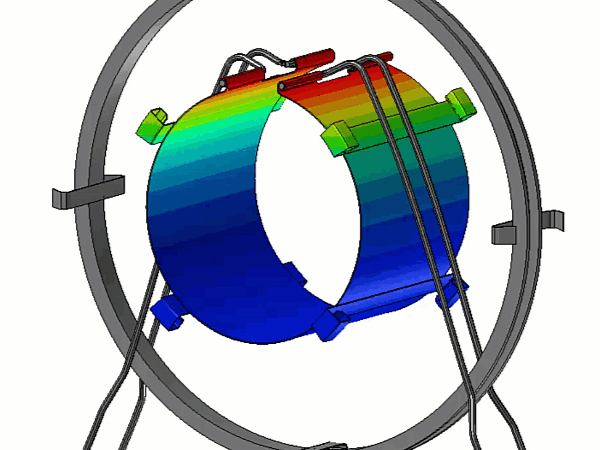
Data is crucial, but human beings are visual creatures. Investors see hundreds of pitch decks a week filled with text and standard graphs. CAE design provides high-fidelity, color-coded visual charts—such as stress concentration heatmaps or aerodynamic airflow animations—that make complex engineering instantly understandable. These visuals serve as powerful communication tools during a pitch. They transform abstract engineering concepts into tangible, professional proof. When an investor sees a highly detailed simulation animation, it builds immediate trust that the startup is running a sophisticated operation, drastically increasing the likelihood of securing the funding round.
Author: Caesar Wiratama
Find me on Linkedin