
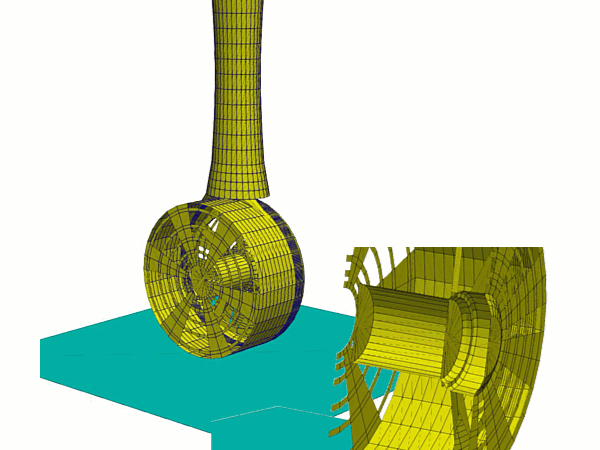
Consumer electronics lead a hazardous life. A portable, handheld fan is destined to be dropped on concrete sidewalks, shoved into crowded backpacks, and knocked off bedside tables. For a hardware startup, a single weak point in the plastic housing can lead to shattered products, high return rates, and a damaged brand reputation. While traditional manufacturing relies on a destructive cycle of molding, dropping, breaking, and remolding physical prototypes, Finite Element Analysis (FEA) allows startups to simulate these violent impacts digitally. By testing durability virtually, entrepreneurs can engineer rugged, drop-proof products while saving thousands of dollars in tooling costs.
The Digital Prototyping Lab: How FEA Simulates Impact
At its core, FEA is a computational method that predicts how a physical object will react to real-world forces, such as impacts, vibrations, or heat. To perform a virtual drop test, engineers import the 3D CAD model of the handheld fan into the FEA software. The software then breaks down the complex geometry of the plastic shell, internal motor, and battery brackets into a mesh consisting of millions of tiny, interconnected geometric shapes called elements.
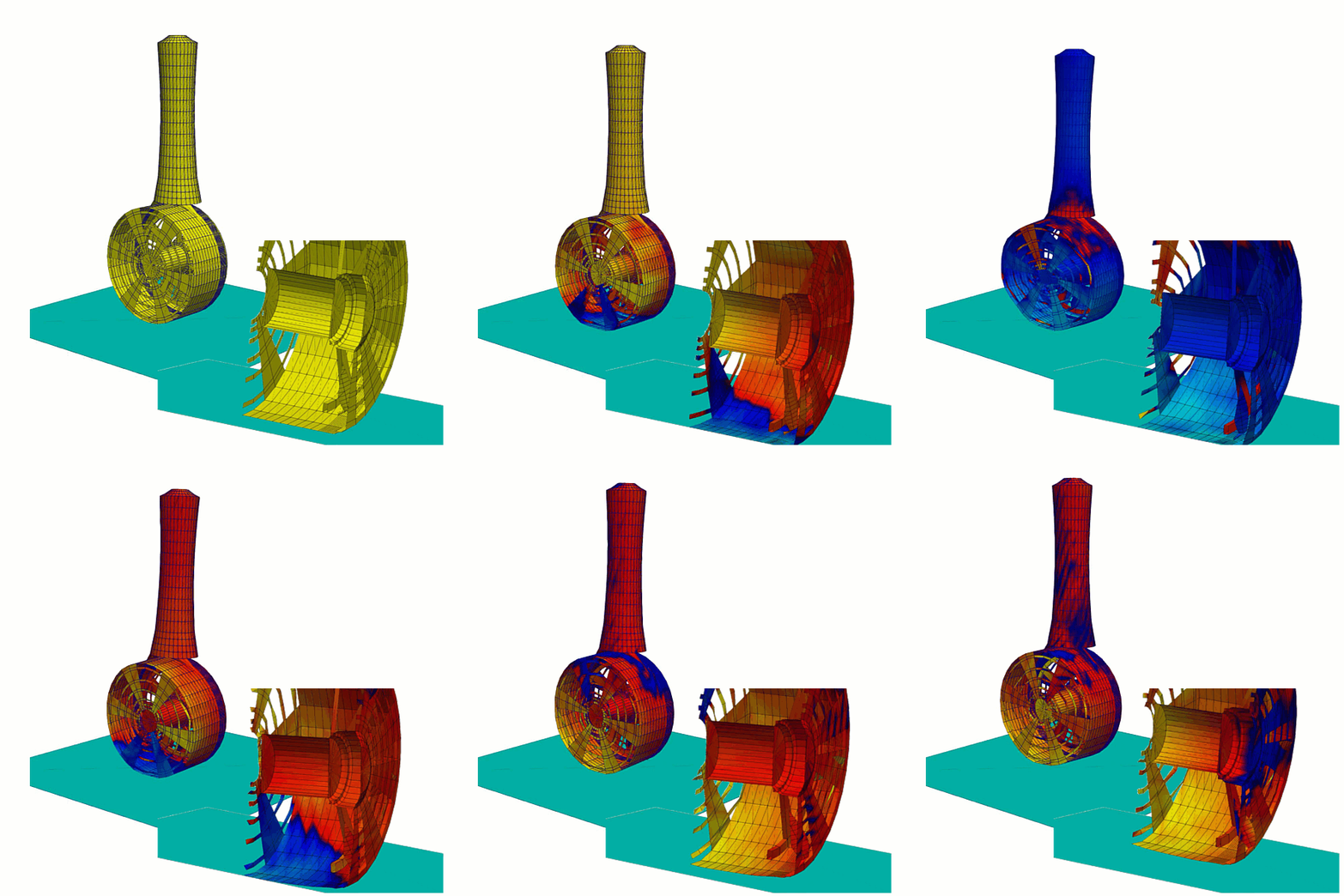
Each element is assigned the exact mathematical properties of the chosen production material—such as Acrylonitrile Butadiene Styrene (ABS) or Polycarbonate (PC) plastic. The software is then programmed with real-world physics constraints: the fan is given a specific orientation, accelerated by gravity, and slammed into a rigid virtual surface. Within hours, the simulation calculates how the energy of the impact travels through the product millisecond by millisecond.
Mapping the Stress: Identifying Points of Failure
When a physical fan hits the ground, it breaks invisibly fast, leaving engineers to guess exactly where the failure started. FEA solves this by generating high-resolution, color-coded visual animations of the impact. High-stress concentrations are highlighted in bright red, while safe zones remain blue.
This visualization allows a startup to pinpoint hidden vulnerabilities that would be impossible to detect otherwise. For instance, the simulation might reveal that when the fan lands on its handle, the shockwave travels upward and concentrates intensely around the internal screw bosses holding the electric motor. Without FEA, a startup might only discover during mass production that these internal posts snap upon impact, causing the motor to break loose and jam the blades. FEA catches these flaws on the computer screen long before any manufacturing capital is committed.
Optimizing Material Distribution and Weight
Once the stress concentrations are identified, the natural impulse might be to make the entire plastic housing thicker. However, for a handheld device, adding excess material increases the overall weight, ruins ergonomics, and raises manufacturing costs. FEA enables a highly strategic approach to structural reinforcement.
Instead of thickening the entire shell, engineers can use the simulation data to add thin, structural ribs only in the specific areas where stress peaks. Conversely, they can safely remove material from the blue, low-stress zones to save weight. FEA also allows startups to virtually experiment with different material blends. A team can easily swap standard ABS for a higher-grade polycarbonate blend in the software to see if the increased material cost justifies the jump in drop survival rate, optimizing the balance between product cost and rugged durability.
Securing Interlocking Joints and Snap-Fits
Most handheld electronics do not rely solely on screws; they use interlocking snap-fits and seams to hold the housing together. During a drop, the rapid deformation of the plastic causes these joints to flex violently. If the snap-fits are too rigid, they will shear off; if they are too loose, the fan will split wide open upon impact, scattering internal components everywhere.
Through FEA dynamic impact analysis, a startup can study the exact behavior of these mating surfaces during a crash. Engineers can refine the hook angles and wall thicknesses of the snap-fits to ensure they possess enough elasticity to absorb the impact energy without unlatching. By perfecting these micro-geometries in the virtual environment, the startup ensures that the final physical product feels premium, robust, and completely seamless in the hands of the consumer, surviving everyday accidents with ease.
Author: Caesar Wiratama
Find me on Linkedin