
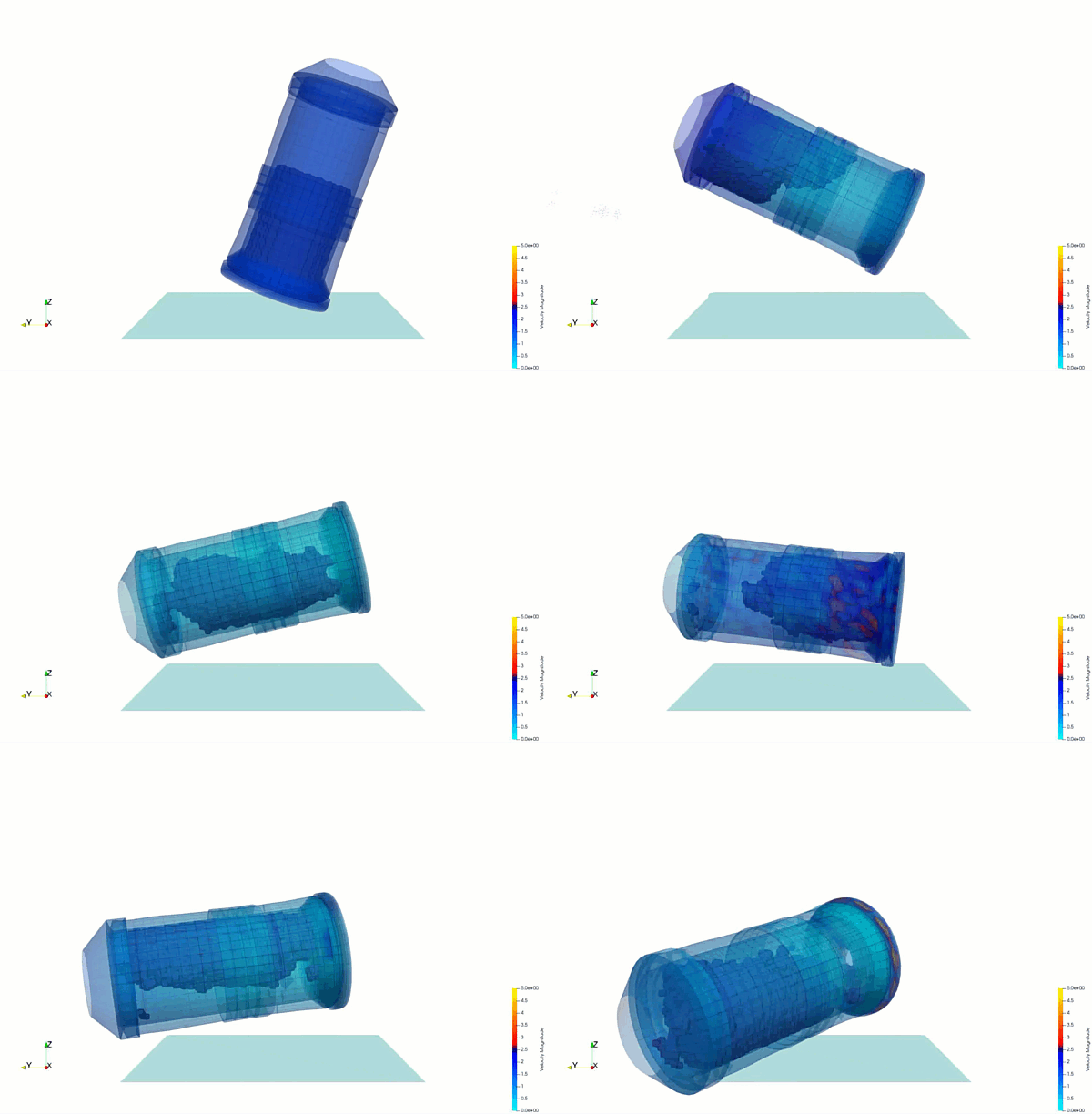
The journey of bringing a new hardware product to market is filled with hidden costs, and for hardware startups designing a reusable tumbler, structural durability is often the biggest hurdle. A tumbler must survive everyday drops onto concrete, accidental slips from backpacks, and constant wear and tear. Historically, testing this durability meant building physical prototypes, renting expensive testing equipment, and dropping the product repeatedly until it broke—only to repeat the entire cycle after making design modifications. For a resource-constrained startup, Finite Element Analysis (FEA) drop test simulation transforms this chaotic, expensive process into a streamlined, predictable digital workflow. By simulating impact forces inside a computer, startups can drastically improve their business processes, save capital, and accelerate their time-to-market.
Eliminating the Financial Burden of Physical Prototyping
For any early-stage company, cash flow management is a matter of survival. Traditional product development relies heavily on creating multiple iterations of physical prototypes, which requires expensive tooling, injection molding adjustments, or CNC machining. Every time a physical drop test fails—whether the plastic lid shatters or the vacuum-insulated stainless steel body dents severely—the startup must pay for new molds and materials. FEA drop test simulation replaces this destructive trial-and-error cycle with virtual testing. Engineers can stress-test dozens of different wall thicknesses, material blends, and lid geometries in a digital environment for a fraction of the cost. By minimizing the number of physical prototypes needed before mass production, startups can reallocate tens of thousands of dollars toward marketing, inventory, and customer acquisition.
Accelerating Product Development Cycles
Speed is a massive competitive advantage in the consumer goods market. Waiting weeks for a manufacturing partner to ship a new prototype iteration can stall a startup’s momentum and cause them to miss critical market windows, such as the holiday shopping season. FEA simulations compress these long waiting periods into hours or days. A designer can modify the threading on a tumbler lid, run a digital drop test simulation at various angles, and see the structural results by the end of the day. This rapid feedback loop allows startups to iterate at an unprecedented pace. They can confidently lock in the final, optimized design much faster than competitors relying on manual testing, effectively shrinking the overall product development timeline from years to months.
Engineering a Premium and Reliable Product
In the highly competitive beverage container industry, brand reputation is built on product quality. A startup cannot afford a wave of negative online reviews complaining about leaky lids or easily dented flasks. FEA drop test simulation provides deep, granular insights that physical testing simply cannot match. It highlights exact stress concentrations, tracks shockwave propagation through the fluid inside the tumbler, and predicts precisely where a plastic hinge will fail upon impact. Armed with this data, engineers can reinforce high-stress areas, optimize internal ribbing, and select the perfect material elasticity. This scientific precision ensures that the very first production batch delivered to customers is exceptionally durable, instantly establishing brand trust and reducing costly warranty claims.
Streamlining Supply Chain and Manufacturing Discussions
When a startup transitions from design to mass production, clear communication with manufacturing partners is vital. Manufacturers often push back on complex geometries or specific material choices to save on production costs, which can compromise the product’s strength. Having comprehensive FEA data changes the dynamic of these negotiations. Instead of relying on guesswork, the startup can present concrete engineering reports to factories, proving exactly why a specific wall thickness or material grade is non-negotiable for drop survival. Furthermore, FEA allows startups to design for manufacturing (DFM) early on. By identifying structural weaknesses virtually, they can avoid the nightmare scenario of discovering a fatal design flaw after the factory has already cut expensive steel production molds.
Author: Caesar Wiratama
Find me on Linkedin