
The world of 3D computer-aided design (CAD) has traditionally been a playground for expensive, subscription-heavy software. For independent designers, makers, and small businesses, the financial barrier to entry into professional-grade modeling can be incredibly steep. FreeCAD shatters this barrier by offering a completely free, open-source parametric 3D modeler. It is designed to create real-world objects of any size, allowing users to modify designs easily by going back into their modeling history and changing specific dimensions.
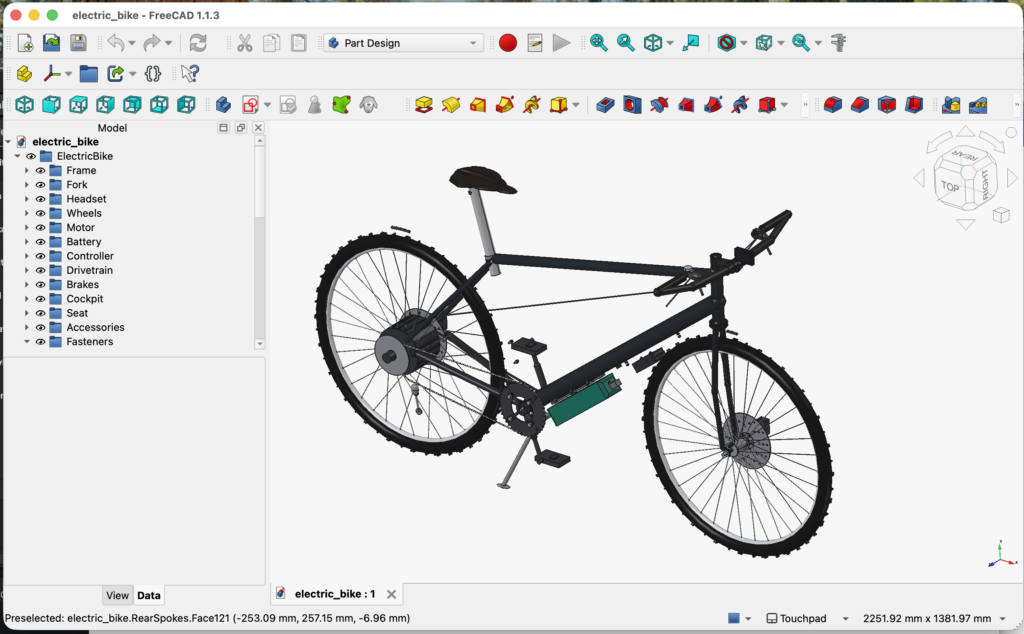
FreeCAD user interface
Unlike traditional design software controlled by a single corporation, FreeCAD belongs to its global community of users and developers. It operates under an open-source license, meaning anyone can download it, use it for personal or commercial projects, and even modify the underlying source code. This makes it an incredibly resilient piece of software that adapts to the diverse needs of its community, rather than the profit motives of a corporate boardroom.
The Power of Parametric Modeling
At its core, FreeCAD relies on parametric modeling. This design philosophy means that the shapes you build are driven by properties, constraints, and numerical values. Instead of manually pushing and pulling faces like virtual clay, you draw a 2D sketch, lock down its dimensions with geometric rules, and then extrude or revolve that sketch into a 3D object. If you realize later in the design process that a bolt hole needs to be slightly wider, you do not have to rebuild the model from scratch. You simply change the diameter value in the original sketch, and the entire 3D object recalculates automatically.
Modular Workbenches for Diverse Industries
One of FreeCAD’s unique architectural strengths is its system of “Workbenches.” Think of the software as a digital workshop where you can change the tools on your desk with the click of a button. Each workbench is a collection of tools tailored to a specific task. The Part Design workbench handles mechanical prototyping, while the BIM (Building Information Modeling) workbench provides tools for architectural layouts and construction data. There are workbenches specialized for technical drawing generation, sheet metal design, and even robot simulation, allowing professionals across entirely different industries to operate inside the exact same program.
An Open Extension Ecosystem
FreeCAD’s capabilities extend far beyond its default features, thanks to its deep integration with the Python programming language. Virtually every action you take in the graphical interface executes a line of Python code in the background. This transparency allows advanced users to write scripts to automate repetitive modeling tasks. Furthermore, an integrated Addon Manager gives users access to hundreds of community-developed plugins and workbenches. This open extension pipeline ensures that FreeCAD continuously evolves, adopting new features and workflow optimizations at a pace that proprietary rivals struggle to match.
A Critical Link in Modern Open-Source Ecosystems
FreeCAD is rarely used in isolation; it serves as a critical bridge between digital concepts and physical objects. It natively exports to standard files like STEP, IGES, and STL, making it fully compatible with industrial manufacturing pipelines. For makers, it feeds 3D models smoothly into slicing software for 3D printing. For advanced engineering firms, FreeCAD features a built-in Finite Element Analysis (FEA) workbench powered by the CalculiX solver. This allows designers to test structural stresses directly on their models without leaving the application, positioning FreeCAD as a viable, accessible cornerstone for full-scale open-source engineering setups.
Author: Caesar Wiratama
Find me on Linkedin
Related Search: FreeCAD Freelancing Service, code_aster Freelancing Service, Calculix Freelancing Service, OpenRadioss Freelancing Service, OpenFOAM Freelancing Service,