
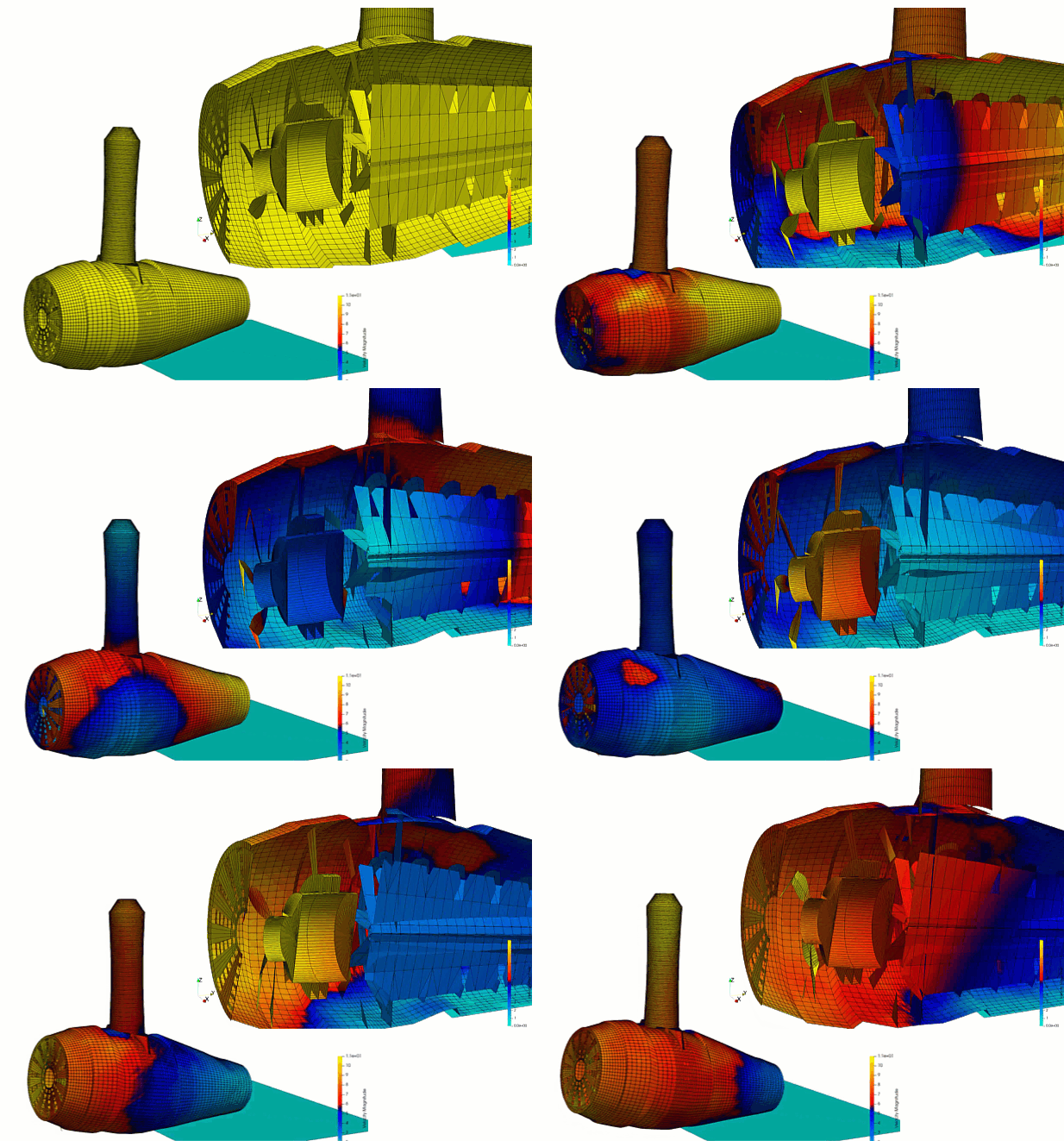
Using Finite Element Analysis (FEA) to simulate drop tests has become a game-changer for hardware companies, especially those designing consumer electronics like hair dryers. Historically, testing the durability of a handheld device meant building physical prototypes, dropping them from various heights, and observing where they cracked. This trial-and-error approach is incredibly slow and expensive. By migrating this entire workflow into a virtual engineering environment, businesses can predict exactly how a hair dryer will behave when it hits a hard floor long before a single piece of plastic is ever molded.
How FEA Simulates a Hair Dryer Drop Test
FEA works by digitally breaking down the complex geometry of a hair dryer into millions of tiny, interconnected geometric shapes called elements. When a engineer simulates a drop, the software applies the laws of physics—such as gravity, velocity, and material properties—to this digital mesh. As the virtual hair dryer impacts a simulated surface, the software calculates how impact energy propagates through the outer shell, the heating element, the fan motor, and the internal electrical wiring.
This digital simulation captures high-speed phenomena that are almost impossible to see with the naked eye during a physical test. Engineers can pinpoint precise locations experiencing high stress concentrations, identify snap-fits that might come undone, and catch internal components that might clash upon impact. Because hair dryers are made of complex polymers and contain delicate internal electronics, FEA allows designers to test different drop angles—such as a direct impact on the nozzle versus a landing on the handle—with absolute mathematical precision.
Accelerating Time-to-Market
From a business process standpoint, the most immediate benefit of FEA drop testing is a massive reduction in the product development cycle. In a traditional workflow, discovering a structural weakness during physical testing forces a company to redesign the part, modify the manufacturing molds, and wait weeks for new prototypes to be produced. This cycle can derail launch timelines. FEA compresses this feedback loop from weeks to hours. Designers can identify a weak point in the morning, modify the digital CAD model, and rerun the drop simulation by the afternoon. For startups trying to hit tight market windows or outpace competitors, this agility is a massive competitive advantage.
Drastic Reductions in R&D Costs
Developing physical injection molds for a hair dryer shell can cost tens of thousands of dollars, and modifying those molds due to a failed drop test adds substantial penalties. FEA virtually eliminates the need for multiple rounds of physical prototyping. By ensuring that the product is structurally sound before investing in hard tooling, startups and established brands alike can protect their capital. Money that would have been spent on sacrificial prototypes, laboratory testing equipment, and mold re-tooling can instead be reallocated toward marketing, user experience design, or software features.
Enhancing Product Quality and Brand Reputation
In the consumer electronics market, a product that breaks easily leads to negative online reviews, high return rates, and a damaged brand reputation. FEA allows engineering teams to optimize the structural integrity of the hair dryer without simply making it thicker and heavier. By analyzing the simulation data, engineers can add structural ribs only where they are truly needed, maintaining a lightweight and ergonomic design while maximizing durability. Delivering a robust product on day one minimizes warranty claims and fosters customer trust, which is vital for a startup building its initial user base.
Fostering Innovation through Risk-Free Exploration
When physical testing is the only option, engineering teams tend to play it safe, sticking to conservative, bulky designs to avoid costly failures. FEA creates a risk-free sandbox environment that encourages true innovation. Designers can experiment with radical new aesthetics, ultra-thin wall geometries, or sustainable, recycled plastics without the fear of financial penalty if the first iteration fails. The software reveals exactly how alternative materials or novel shapes will perform under stress, allowing companies to push the boundaries of modern industrial design safely and confidently.
Author: Caesar Wiratama
Find me on Linkedin