
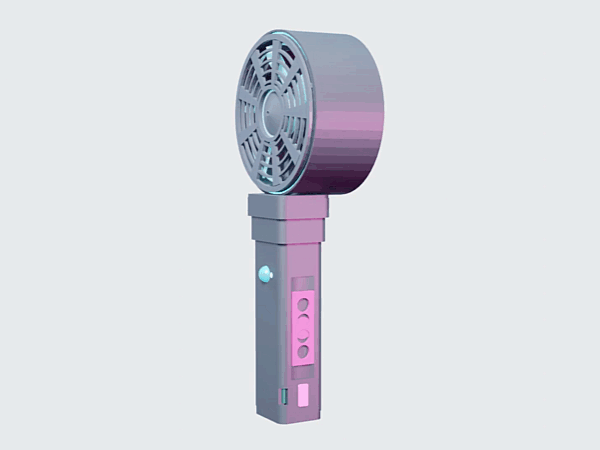
For product designers, engineers, and startups, the ability to quickly transform a digital 3D model into a physical object is a superpower. Rapid prototyping bridges the gap between concept and validation, allowing teams to test form, fit, and function before committing to expensive mass-production tooling. However, choosing the right fabrication process can be overwhelming. The ideal method depends entirely on what you need to test—whether it is the visual aesthetic, mechanical strength, or fluid sealing. Navigating the modern rapid prototyping landscape requires understanding the core fabrication methods available and matching them to your specific engineering goals.
3D Printing (Additive Manufacturing)
Additive manufacturing builds parts layer by layer from the ground up, making it the most accessible and widely used rapid prototyping option. It is highly valued for its ability to produce complex geometries that would be impossible to manufacture using traditional subtractive methods. Within 3D printing, three primary technologies dominate the prototyping landscape:
- Fused Deposition Modeling (FDM): FDM melts and extrudes thermoplastic filaments (like PLA, ABS, or PETG) through a heated nozzle. It is the most cost-effective and rapid option for early-stage conceptual models and basic fit testing, though surfaces often display visible layer lines.
- Stereolithography (SLA): SLA utilizes a UV laser to selectively cure liquid photopolymer resin into solid plastic layers. This process delivers exceptional surface finish and sharp details, making it perfect for high-fidelity visual prototypes, cosmetic mockups, and intricate form-factor testing.
- Selective Laser Sintering (SLS): SLS uses a high-powered laser to fuse micro-particles of powdered material, typically nylon. Because the surrounding unsintered powder acts as a natural support structure, SLS can create complex, interlocking designs without geometric limitations. SLS parts are highly durable and structurally isotropic, making them ideal for rigorous functional and mechanical testing.
CNC Machining (Substractive Manufacturing)
Computer Numerical Control (CNC) machining is a subtractive process where a computer-driven cutting tool carves away material from a solid block. While 3D printing is excellent for speed and complexity, CNC machining is the gold standard for material authenticity and precision.
CNC prototyping allows engineers to test components made from the exact end-use materials, including production-grade plastics (like Delrin or Polycarbonate) and metals (like Aluminum, Stainless Steel, or Brass). The process delivers incredibly tight tolerances and smooth surface finishes. If your prototype requires high mechanical strength, thermal conductivity, or precise threaded connections—such as a structural brackets or motor housings—CNC machining is often the most reliable pathway, despite its higher initial cost and setup time compared to 3D printing.
Urethane Casting (Bridge Tooling)
When a design is finalized but mass production molds are not yet ready, urethane casting serves as an excellent intermediary process. It is a multi-step technique where a master prototype (typically made via high-resolution SLA 3D printing) is encapsulated in liquid silicone to create a flexible mold. Once the silicone cures, it is cut open, the master is removed, and polyurethane resins are poured into the cavity to create duplicates.
Urethane casting is highly efficient for short-run prototyping (10 to 100 parts). It yields components that closely mimic the material properties, color, texture, and surface quality of final injection-molded plastics. Startups frequently leverage this method to produce high-fidelity units for field testing, regulatory certifications, or early marketing displays without investing tens of thousands of dollars in hard steel tooling.
Sheet Metal Prototyping
For products that rely on enclosures, brackets, or structural chassis, sheet metal fabrication is the primary rapid prototyping option. This process involves cutting flat sheets of metal (usually steel, aluminum, or copper) using lasers or waterjets, and then bending, punching, and welding them into 3D shapes.
Rapid sheet metal shops utilize universal forming tools and programmable press brakes to construct prototypes in a matter of days. This method is critical for validating structural integrity, electromagnetic shielding (EMI), and thermal management in electronics enclosures and industrial equipment, ensuring the design can be easily replicated in mass production.
Matching the Process to the Prototype Stage
Selecting the right fabrication option requires balancing speed, cost, and fidelity based on your current development phase. Early-stage “looks-like” or “works-like” concepts are best suited for fast, low-cost FDM or SLA 3D printing. As the design matures into functional testing, transitioning to SLS printing, CNC machining, or sheet metal ensures the prototype can withstand real-world physical stresses. By strategically deploying these varied rapid prototyping technologies, product teams can aggressively iterate, minimize development risks, and accelerate their timeline to market.
Author: Caesar Wiratama
Find me on Linkedin