
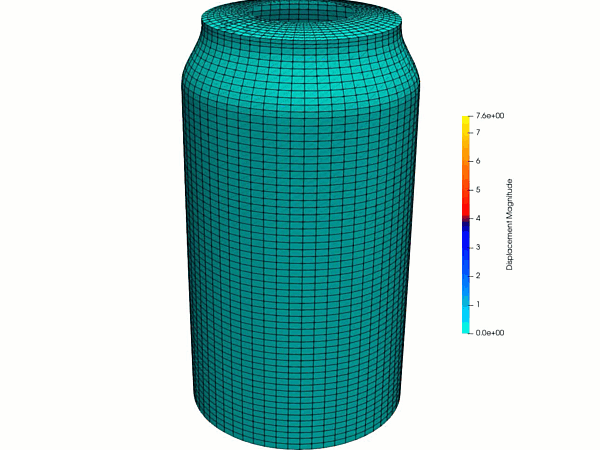
In today’s fast-paced manufacturing landscape, companies face intense pressure to reduce time-to-market, minimize material costs, and improve product sustainability. Traditional trial-and-error development methods, which rely heavily on physical prototyping and destructive testing, are increasingly becoming financial liabilities. To remain competitive, forward-thinking businesses are turning to advanced engineering tools. Among these, non-linear Finite Element Analysis (FEA) has emerged as a critical technology for predicting how products behave under extreme real-world conditions before a physical prototype is ever built.
When analyzing highly complex physical phenomena—such as large deformations, material tearing, and high-speed impacts—standard linear FEA falls short. Non-linear FEA accounts for shifting material properties, changing contact zones, and geometric distortions. By implementing open-source, industrial-grade solvers like OpenRadioss, companies can simulate these intricate behaviors with extreme accuracy. A prime example of this technology in action is the simulation of an aluminum beverage can undergoing a crushing force, a test case that perfectly illustrates how non-linear FEA drives corporate value.
The Complexity of Aluminum Can Crushing
An aluminum beverage can may seem like a simple object, but its structural behavior under load is highly complex. The engineering behind a modern can requires balancing material thinness with structural integrity. When a can is subjected to an axial crushing force, it undergoes rapid buckling, severe geometric deformation, and localized material yielding.
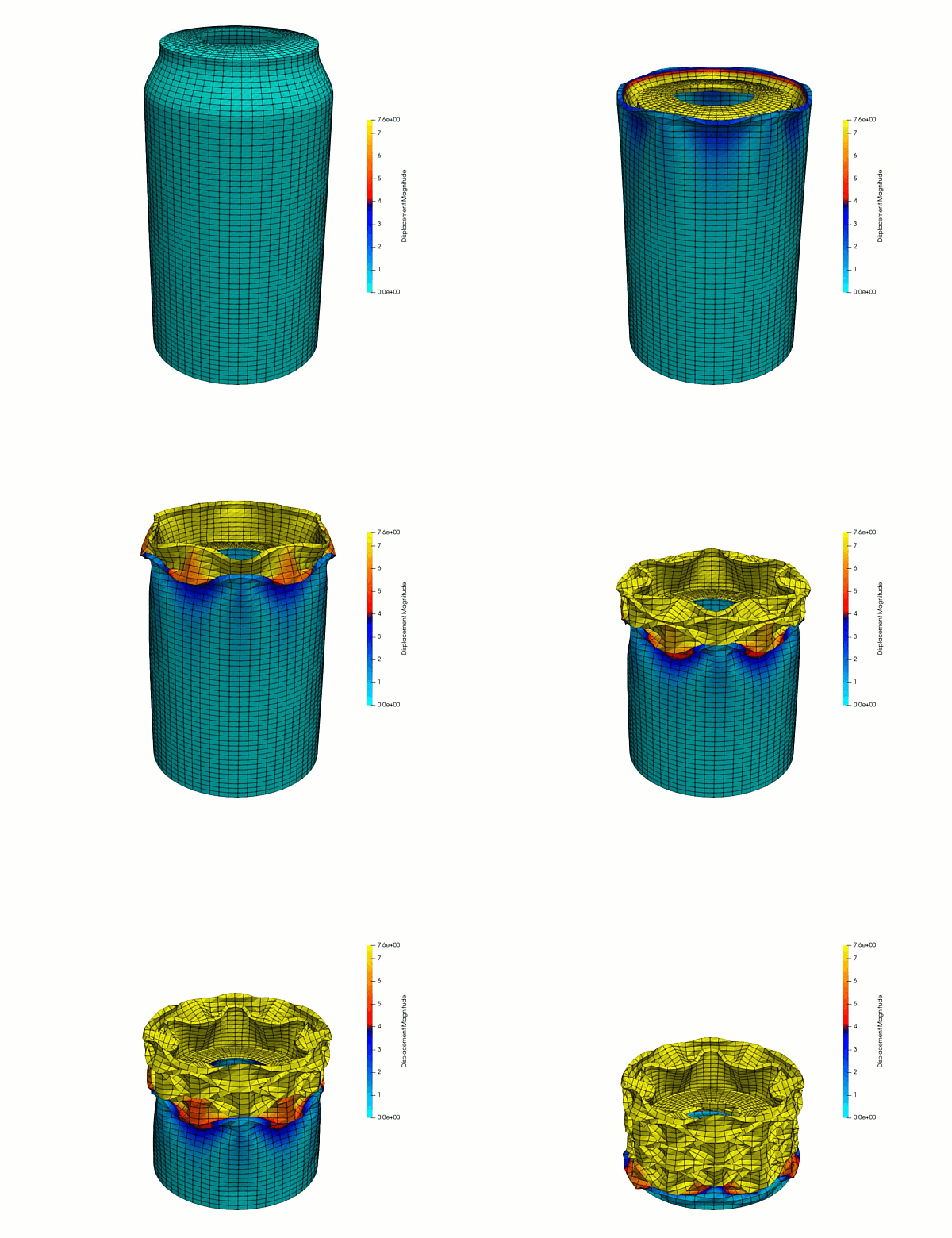
Simulating this process requires a solver capable of handling explicit dynamics and non-linearities. OpenRadioss excels in this domain. A proper non-linear simulation tracks how the thin aluminum walls fold, how the internal pressure (if the can is sealed) changes, and how different parts of the metal come into contact with one another. This level of detail allows engineers to see exactly where the structural weak points are and how the failure propagates through the geometry over milliseconds.
Accelerating Innovation and Design Optimization
For a development team, the primary advantage of utilizing OpenRadioss for can crushing simulations is the ability to rapidly iterate on designs. In a digital environment, engineers can alter the wall thickness, modify the bottom dome geometry, or introduce new aluminum alloys, and instantly test how those changes affect crush resistance.
Instead of waiting weeks to re-tool a manufacturing line and stamp out physical prototypes for mechanical testing, a company can run dozens of virtual simulations simultaneously. This drastically shortens the design cycle. It empowers engineering teams to explore innovative, radical geometries that they might otherwise discard due to the time and cost constraints of physical testing.
Substantial Cost Reduction in Materials and Prototyping
In the beverage industry, where billions of cans are produced annually, saving even a fraction of a millimeter in wall thickness translates to millions of dollars in material cost savings. Non-linear FEA allows companies to confidently engage in “lightweighting”—the process of reducing material use without sacrificing structural integrity during shipping, stacking, or handling.
OpenRadioss enables engineers to find the precise threshold where a can remains strong enough to survive the supply chain but uses the absolute minimum amount of aluminum. Furthermore, by replacing expensive physical drop tests, axial compression tests, and tooling adjustments with virtual simulations, companies slash their R&D overhead and minimize material waste during the development phase.
Mitigating Risk and Ensuring Supply Chain Reliability
Product failures in the consumer goods sector can lead to costly recalls, damaged brand reputation, and strained relationships with retailers. If a batch of beverage cans buckles prematurely under the weight of a shipping pallet, the financial fallout can be severe.
By integrating non-linear FEA into the product development workflow, companies can simulate worst-case transportation and warehousing scenarios. OpenRadioss provides deep insight into structural safety margins, ensuring that products arriving on store shelves are robust and reliable. This predictive capability effectively mitigates engineering risks before mass production begins, protecting both the consumer experience and the company’s bottom line.
Maximizing ROI with Open-Source Solvers
While commercial non-linear FEA software carries steep licensing fees that scale with the number of computing cores used, open-source alternatives like OpenRadioss change the economic equation. Companies can scale their simulation workloads across massive high-performance computing (HPC) clusters without incurring exponential software costs.
This democratization of advanced simulation means that small and medium-sized enterprises can leverage the same high-end predictive power as industry giants. Ultimately, utilizing OpenRadioss for complex non-linear simulations delivers a profound competitive advantage, transforming product development from a reactive process of fixing physical failures into a proactive strategy of digital optimization.
Author: Caesar Wiratama
Find me on Linkedin