
Redefining Product Development: How CFD and DEM Saved a Cyclone Vacuum Cleaner Design
In the highly competitive consumer appliance industry, delivering high suction power while maintaining optimal filtration efficiency is a critical engineering challenge. For modern bagless household vacuum cleaners and premium dust collectors, the cyclone separator is the core component responsible for this task. It relies entirely on centrifugal forces generated by a swirling airflow to fling household dust, pet hair, and microscopic debris against a cylindrical wall, where they lose momentum and drop into a collection bin. On paper, the internal geometry looks deceptively simple—a cylindrical top section connected to a conical bottom with a tangential air inlet. However, the fluid and particle dynamics inside are notoriously complex. For appliance brands looking to bring new products to market, traditional trial-and-error prototyping can quickly turn into a financial black hole.
By utilizing advanced computational tools, engineers can peek inside the invisible vortex of a vacuum’s suction chamber before building a single physical prototype. This article explores a comparative case study of two product design scenarios modeled using OpenFOAM for fluid dynamics and LIGGGHTS for particle simulation, coupled together via the CFDEM framework. The results demonstrate how a sub-millimeter change in a vacuum’s internal dimensions can dramatically alter performance, transforming an inefficient failure into an optimized consumer success.
Scenario A: The Trapped Dust Failure
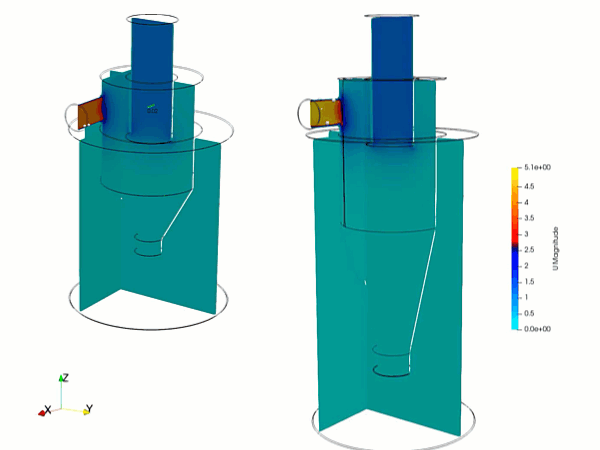
In the first development scenario, an engineering team designed a baseline vacuum cyclone chamber using standard empirical formulas. The initial physical geometry fit perfectly within the sleek aesthetic footprint of a consumer vacuum cleaner, and the air velocity entering the tangential inlet matched standard household blower specifications. To evaluate real-world performance, the team deployed OpenFOAM to resolve the continuous air phase utilizing high-fidelity turbulence models. Concurrently, LIGGGHTS tracked the discrete dust and hair particles, fully accounting for particle-to-particle collisions, friction against the plastic walls, and momentum exchange through the CFDEM coupling framework.
The simulation results revealed a catastrophic performance failure that would ruin consumer satisfaction. While the air successfully formed a primary outer vortex, the dust particles were not separating into the collection bin. Instead, the simulation visualized a dense ring of dust permanently circling around the lower section of the cylinder, right at the junction where it meets the cone. Because the internal dimensions created an unfavorable pressure gradient and a misaligned vortex core, the centrifugal force was perfectly counterbalanced by the upward aerodynamic drag of the inner, rising air vortex. The dust simply refused to drop. In a retail product, this phenomenon would lead to rapid internal static buildup, micro-abrasion of the clear plastic bin, immediate clogging of the secondary HEPA filter, and a total loss of suction power within minutes of use.
Scenario B: The Optimized Geometric Tweak
Rather than scrapping the entire aesthetic layout of the vacuum cleaner and starting from scratch, the design team analyzed the CFDEM data to identify the exact root cause. The simulation showed that the dust trap was caused by an improper ratio between the vortex finder depth (the clean air exit pipe at the top leading to the motor) and the total cylinder height, combined with a slightly too shallow cone angle. This geometric combination compressed the length of the downward swirling vortex, preventing it from extending cleanly into the conical bin.
The team implemented Scenario B by applying small, precise dimensional tweaks. They extended the vortex finder slightly lower into the cylinder to guide the incoming dirty airflow more aggressively downward, and they increased the steepness of the cone angle by just a few degrees. When the OpenFOAM and LIGGGHTS coupled simulation was rerun, the transformation was night and day. The localized low-pressure trap disappeared. The modified dimensions altered the internal velocity profiles such that the downward momentum easily overcame the upward drag force near the walls. The simulation captured a beautiful, continuous stream of household dust being thrown against the solid boundaries and immediately sliding down the cone, directly exiting into the collection bin at the bottom. Separation efficiency skyrocketed, achieving near-perfect collection.
Small Tweaks, Massive Performance Shifts
The stark contrast between Scenario A and Scenario B highlights a fundamental truth in household appliance engineering: minor dimensional adjustments can trigger massive nonlinear shifts in product performance. In our case study, the overall product footprint, the inlet velocity, the motor power, and the mass of the vacuum remained practically identical between both scenarios. Yet, one configuration was entirely useless, while the other was highly efficient.
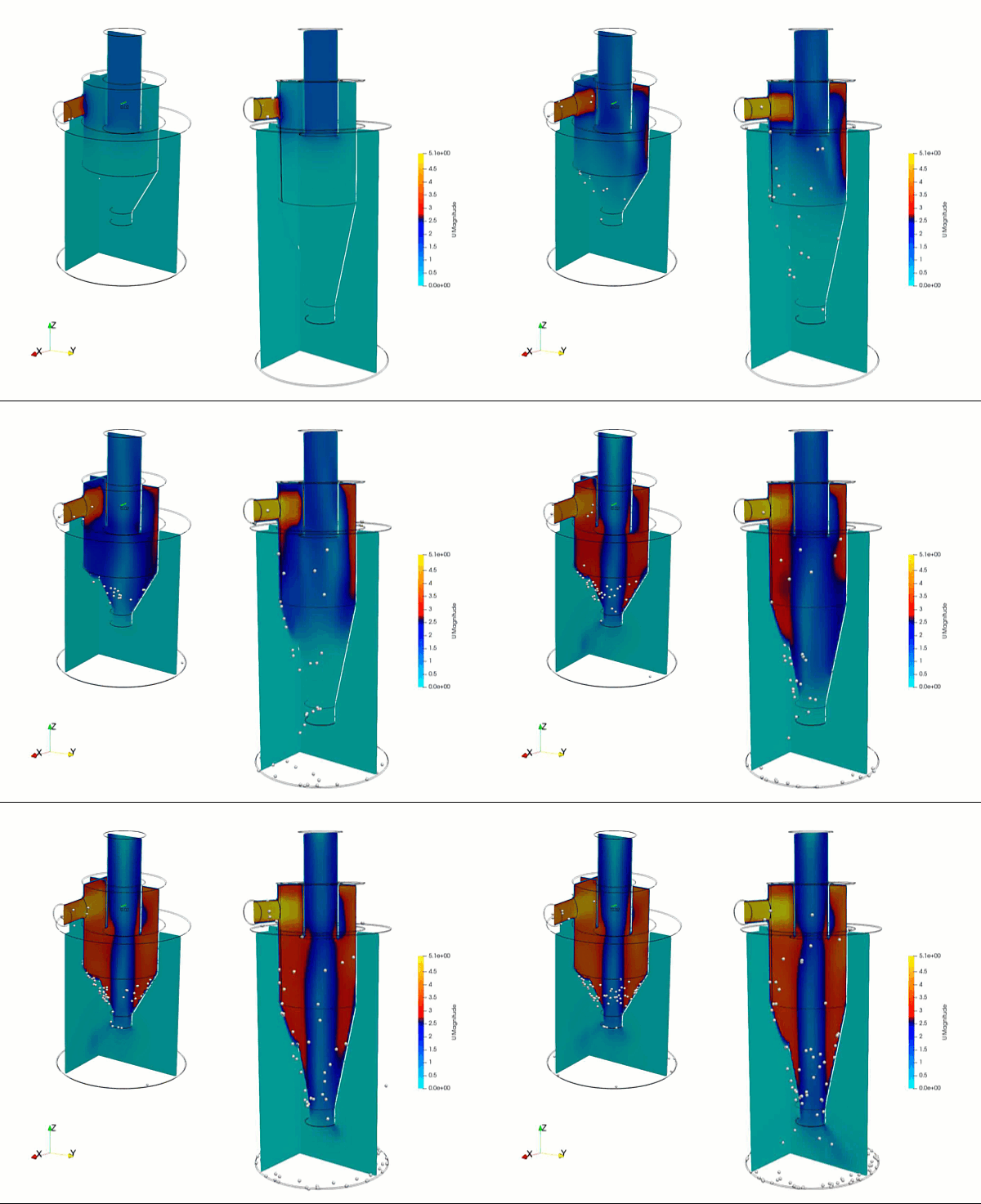
This behavior is incredibly common in products that govern fluid-particle interactions. A millimeter change in a fillet radius, a slight shift in an inlet vane angle, or a minor constriction in a throat area can be the sole deciding factor between a vacuum that works flawlessly and one that gets returned to the store. When fluid dynamics are involved, aesthetic intuition is often a poor guide. Without deep visualization into the pressure distributions and particle trajectories, identifying why a physical prototype is losing suction turns into a blind guessing game.
The True Cost of Traditional Prototyping
Imagine you are an appliance manufacturing company looking to bring a new vacuum cleaner or commercial dust collector to market. If your engineering workflow relies strictly on physical building and testing, Scenario A represents a devastating and costly roadblock.
To discover that dust circles endlessly in the chamber, you first have to pay for expensive plastic injection molds, CNC machining, and assembly of a functional prototype. Next, you must instrument a laboratory test rig with standardized dust testing rooms, flow meters, and particulate counters. When the physical test inevitably fails, your engineers are left looking at a closed plastic container. They can see that dust isn’t dropping into the bin, but they cannot see why. They cannot visualize the trapped vortex core or the invisible balance of drag and centrifugal forces.
This opacity forces companies into an expensive cycle of tool modification and re-molding. You tweak a dimension on a hunch, modify the steel molds, build a second prototype, re-test, and risk failing again. Before long, tens of thousands of dollars are burned, months of market advantage are lost to competitors, and the project risk skyrockets.
Accelerating Innovation with OpenFOAM, LIGGGHTS, and CFDEM
By integrating digital prototyping through open-source computational tools, appliance brands can completely bypass this financial drain. This case study was made possible by the powerful synergy of OpenFOAM, LIGGGHTS, and the CFDEM coupling framework. OpenFOAM provides a robust platform for resolving complex airflow patterns without the burden of restrictive proprietary licensing fees. LIGGGHTS adds highly accurate Discrete Element Method (DEM) physics, treating vacuum dust not as a generic fluid, but as millions of individual spherical and non-spherical particles interacting with each other and the plastic walls.
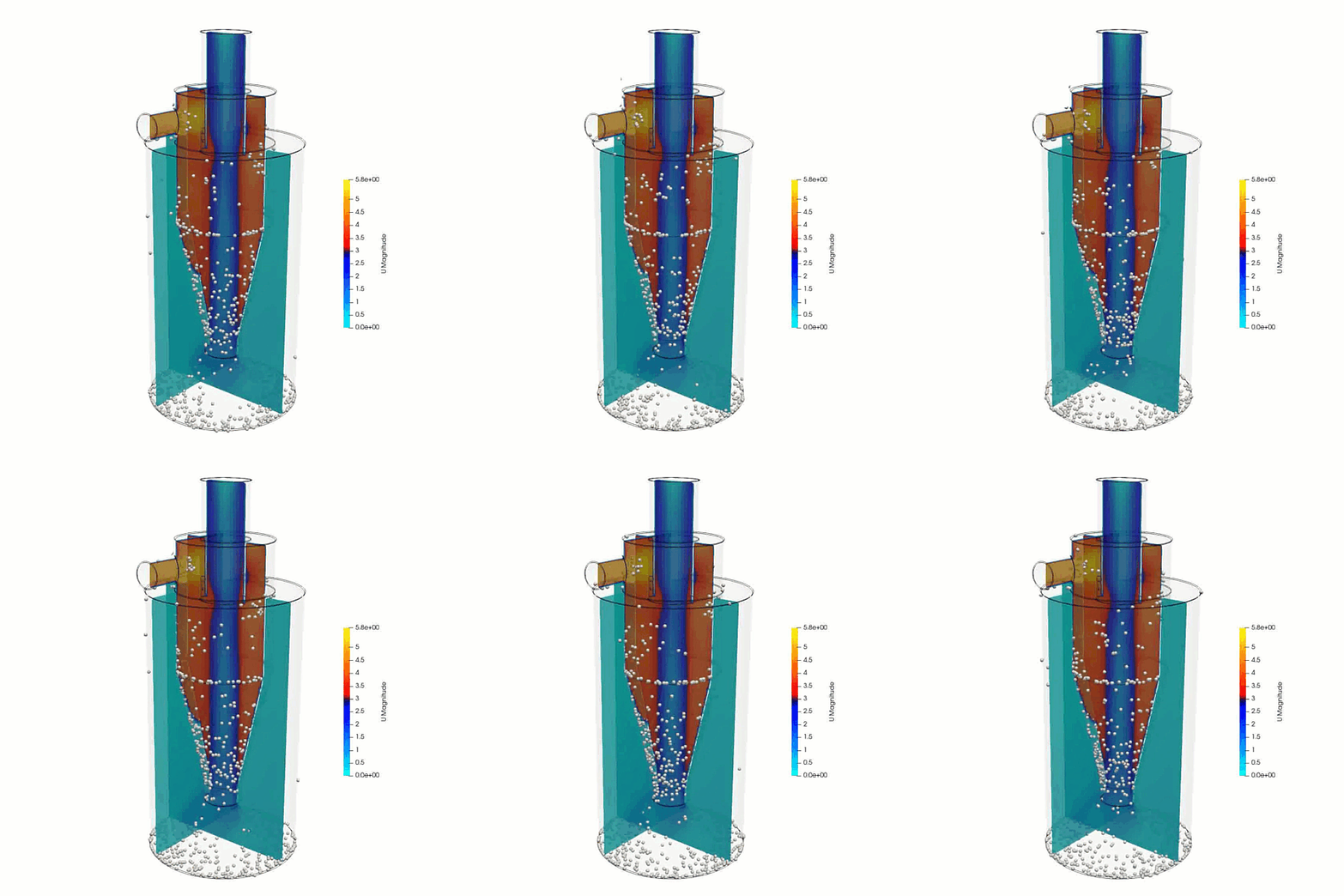
The CFDEM coupling bridges these two worlds, ensuring that as the air moves the dust, the accumulation of dust simultaneously pushes back on the air flow. This bidirectional feedback is crucial for capturing dense particle zones like the trapped ring in Scenario A. Leveraging this open-source software stack allows businesses to run dozens of virtual design iterations simultaneously in the cloud. Engineers can systematically optimize geometries, find the exact inflection points of performance, and validate the appliance digitally. When you finally decide to cut steel for injection molding, you do so with a high degree of confidence that it will work exactly as intended on the very first run. Virtual engineering shifts your expenses from reactive troubleshooting to proactive innovation.
Author: Caesar Wiratama
Find me on Linkedin