
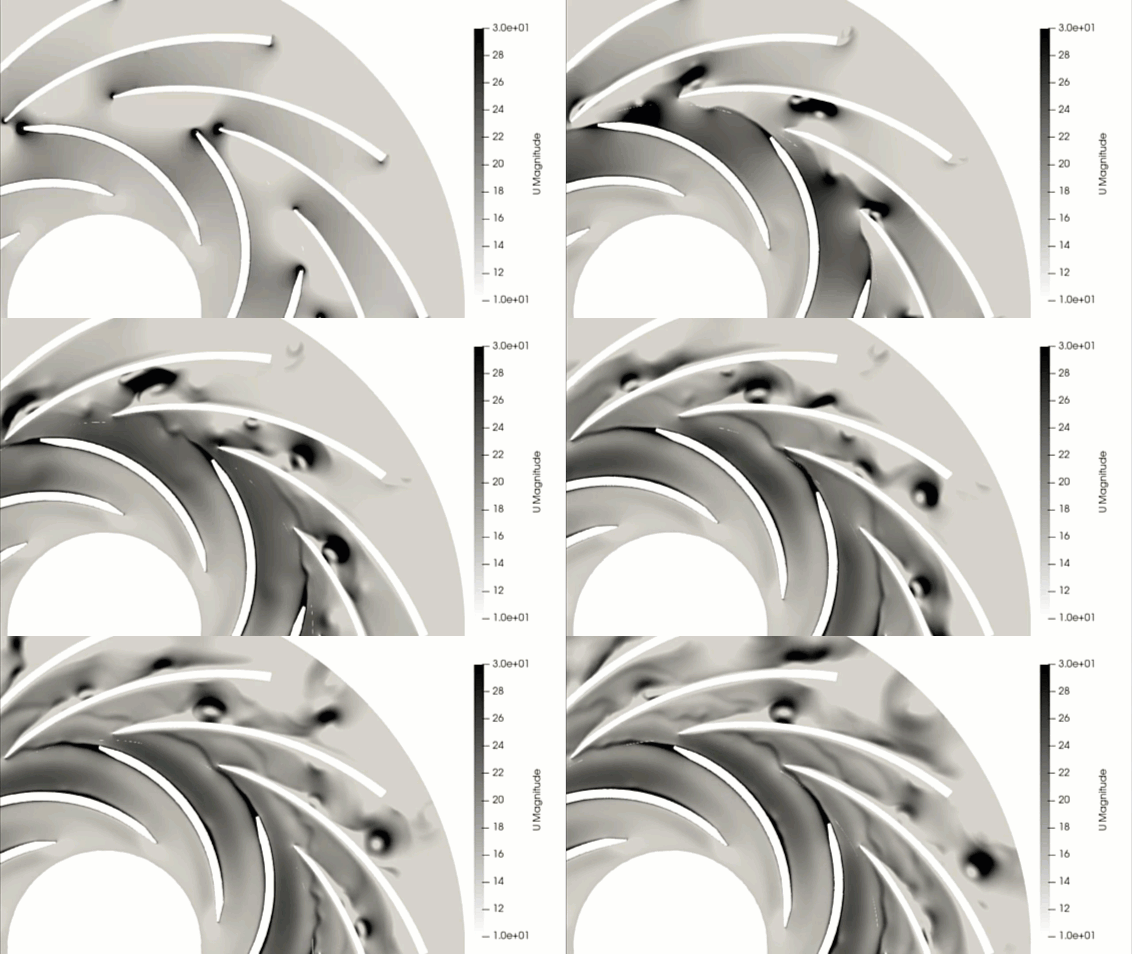
Open-source Computational Fluid Dynamics (CFD) packages like OpenFOAM, SU2, and MFIX have proven themselves as genuinely capable, industrial-grade engineering tools. Major global corporations such as BMW, Mercedes Benz, BASF, Volkswagen, and Intel actively deploy these tools within production environments. The fundamental value of open-source software stems from its absolute cost-free distribution and the legal license it grants engineers to modify, customize, and extend the source code as required for specialized engineering applications. While multiple specialized open-source solvers exist, OpenFOAM remains the most versatile platform due to its broad capabilities in modeling complex multiphysics, including acoustics, combustion, and volume-of-fluid multiphase flows.
The Rise of AI-Driven Simulation Factories
The value proposition of open-source software has evolved past basic licensing cost reduction. Large enterprise organizations use open-source architectures as the foundational substrate for automated, AI-driven simulation factories. Because open-source tools have no licensing constraints per compute core, companies can run thousands of parallelized simulations simultaneously to train AI-native surrogate models. This capability enables real-time design exploration by feeding massive datasets into machine learning algorithms, a practice that would be financially prohibitive under the per-seat or per-token pricing structures of traditional commercial software vendors.
The Hidden Cost of Free Software
While open-source software requires no upfront procurement fees, free code is not equivalent to a cheap overall execution strategy. The true total cost of ownership for open-source tools remains high because the primary financial barrier is shifted to specialized engineering personnel. Running these packages effectively requires advanced command-line scripting, numerical analysis proficiency, and Linux expertise. When factoring in the time-intensive, text-based learning curve and a disconnected native workflow that requires separate applications for meshing and post-processing, the operational overhead can easily surpass the annual subscription fees of comprehensive commercial tools.
Navigating the Divergence of OpenFOAM Versions
Engineers adopting OpenFOAM must navigate two distinct code repositories that have diverged slightly over time. The OpenFOAM Foundation maintains a version that prioritizes architectural cleanliness, mathematical rigor, and long-term stability for academic and fundamental research. Conversely, the ESI-OpenCFD branch focuses on industrial convenience, rapidly integrating community-contributed features and specialized geometry handling tools like the Immersed Boundary Method. Understanding these subtle differences in release schedules and version numbering is critical when determining which repository contains the precise physics solvers required for a corporate product development pipeline.
Overcoming the Historic Linux Barrier
The historic requirement that forced engineers to maintain native Linux environments or cumbersome dual-boot computer architectures to run open-source solvers has been resolved. Modern desktop integration via Windows Subsystem for Linux allows engineers to execute native Linux software distributions with near-native performance directly on a Windows desktop. This integration fully supports graphic user interfaces for post-processing software and enables direct access to simulation files via standard Windows text editors. Furthermore, native graphics processing unit acceleration allows users to leverage advanced graphics hardware for hardware-accelerated, high-performance computing without leaving their primary operating system.
Determining the Optimal Operational Fit
Choosing an open-source framework over a commercial alternative depends entirely on an organization’s specific simulation volume and existing internal capabilities. The open-source model is an optimal strategic fit for large-scale enterprises with massive parallel computing demands and highly specialized, in-house technical teams who can build custom workflows. For smaller engineering teams or companies with irregular project pipelines, the steep text-based learning curve can introduce severe project delays. Smaller operations frequently lower this barrier to entry by using cloud-based software wrappers that add commercial interfaces to open-source solvers, or by partnering with external simulation consultants to navigate the technical trade-offs.
Author: Caesar Wiratama
Find me on Linkedin