
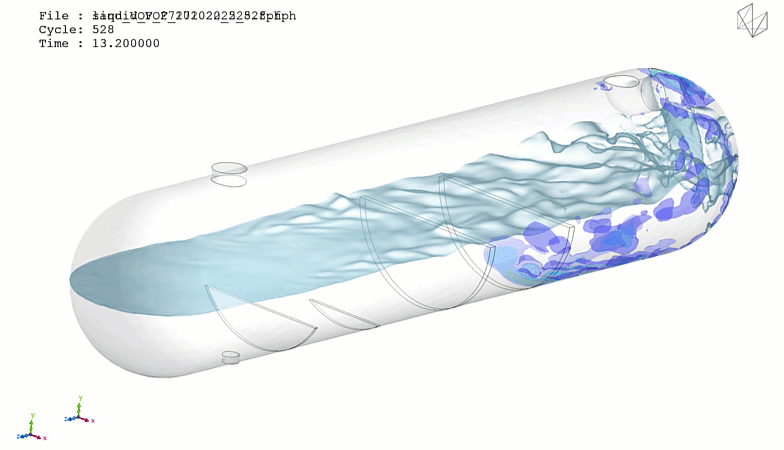
In heavy processing industries—spanning chemical refining, oil and gas production, pharmaceutical manufacturing, and large-scale power generation—the industrial liquid separator is a critical asset tasked with phase isolation. Whether configured as a vertical gas-liquid separator, a horizontal three-phase vessel, or an inline centrifugal cyclonic separator, its sole engineering objective is to isolate liquid droplets or heavy oil phases from a primary carrier fluid stream.
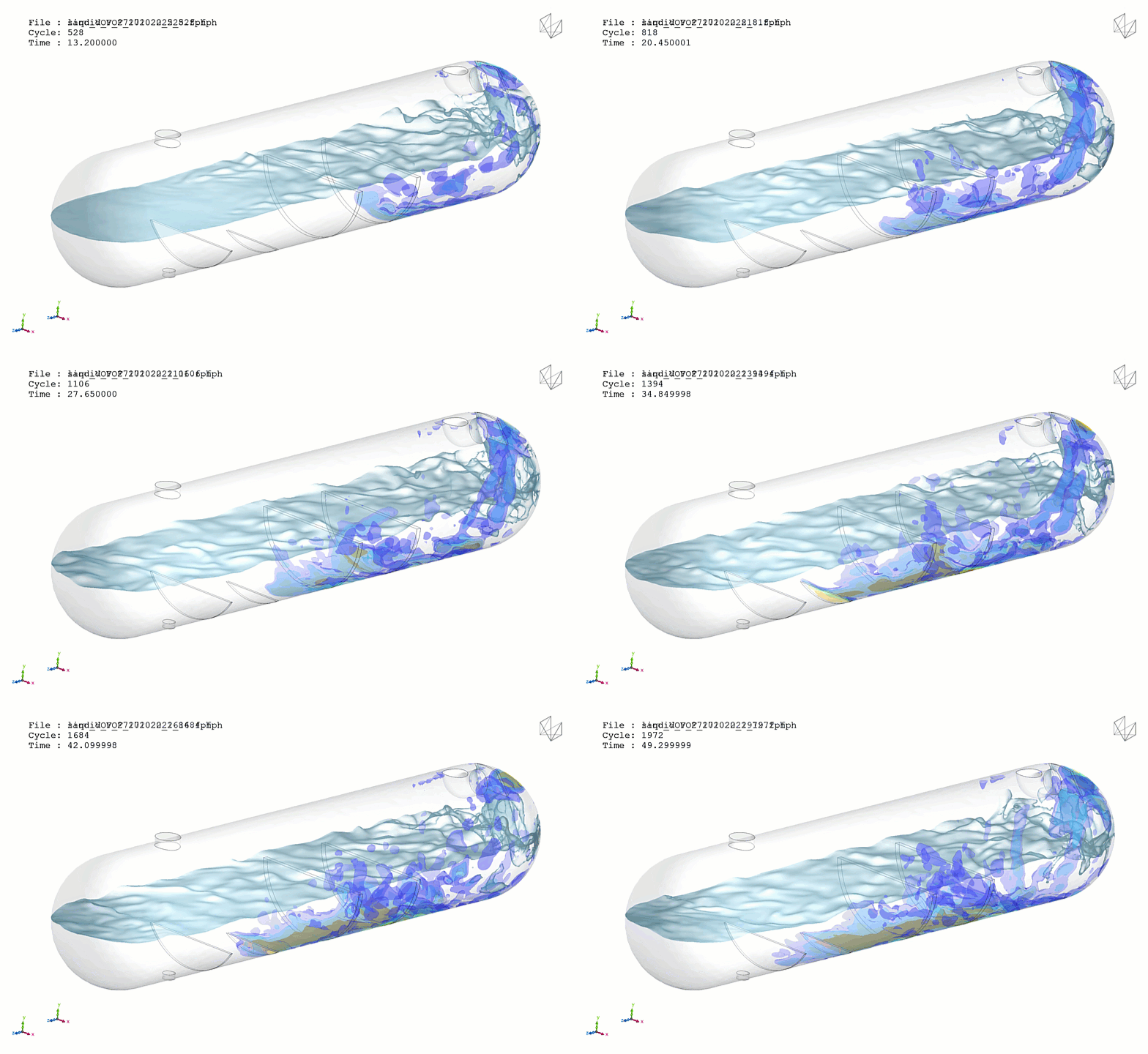
Operating an industrial separator efficiently requires maximizing separation efficiency across all flow rates while strictly managing the vessel’s internal pressure drop. Because even trace liquid carryover can catastrophically damage downstream compressors, poison catalytic beds, or trigger environmental compliance penalties, engineering teams rely heavily on Computational Fluid Dynamics (CFD) to design internal demister pads, optimize inlet wave-breaker plates, and shape cyclonic swirl vanes.
However, simulating an industrial liquid separator is an exceptionally deceptive, highly multi-scale multiphase challenge. Fluid streams do not enter a vessel as a uniform, predictable mixture; they enter as high-velocity, turbulent fluids packed with a broad spectrum of droplet diameters. If your simulation setup flattens these rapid transient dynamics into a steady-state formulation or relies on simplified particle drag models, your solver will suffer from smeared fluid interfaces and remain blind to destructive phase re-entrainment—leaving your design team with highly inaccurate efficiency predictions.
1. The Physics Anchor: Eulerian-Lagrangian Phase Decoupling and Momentum Interfacing
The multi-phase fluid dynamics inside an industrial separator vessel are governed by a dual Eulerian-Lagrangian framework tightly coupled with high-speed surface tension and aerodynamic drag equations. The fluid path transitions rapidly across distinct computational zones:
[Multiphase Stream Enters Vessel] ➔ [Inlet Diverter/Vanes Force Rapid Turning] ➔ [Fluid Core Splits: Displaced Gas Stream & Dense Liquid Phase] ➔ [Solid Droplet Inertia Decouples From Streamlines] ➔ [High-Velocity Wall Striking & Phase Separation]
- The Eulerian Domain (The Continuous Phase): The primary gas or light liquid phase acts as a continuous fluid column. To capture this mathematically, the solver uses traditional Navier-Stokes equations to map the global velocity fields and turbulent eddies moving through the internal vessel galleries.
- The Lagrangian Domain (The Discrete Droplet Phase): The entrained liquid droplets are tracked as distinct Lagrangian points exchanging momentum with the continuous carrier fluid. The particle trajectory relies heavily on the balance between buoyancy forces and aerodynamic drag, calculated across varying droplet size distributions.
- The Phase Decoupling Discontinuity: When the multiphase fluid hits an internal geometric obstruction—such as a vane-type inlet diverter or cyclonic swirl element—the continuous carrier phase turns rapidly to follow the new flow path. Because the liquid droplets possess significantly higher density and inertia, they fail to track the twisting fluid streamlines. They decouple from the flow and slam directly into the separator walls, gathering into a continuous liquid film that drains via gravity into the lower collection well.
2. Industry Context: Where Droplet Capture Safeguards Multi-Million Dollar Capital
Optimizing internal baffle architectures and managing droplet size fields through high-fidelity CFD directly dictates the operational windows, equipment longevity, and financial margins of heavy process facilities:
- Upstream Oil & Gas Production Separators: High-pressure production wells produce a harsh mixture of gas, crude oil, and produced water. Operators use CFD to optimize the layout of internal perforated distribution baffles and horizontal liquid-liquid coalescer packs, ensuring the water phase drops out completely before the oil enters transport lines, preventing internal pipe corrosion.
- Refinery Gas-Liquid Scrubbers and Knockout Drums: Before unrefined refinery gases enter downstream compressor stages, they pass through a compressor suction knockout drum. Engineers use transient CFD to design custom wire-mesh demister pads, ensuring the core gas stream does not suffer from liquid carryover, which would cause immediate mechanical compressor blade failure.
- Ammonia and Petrochemical Synthesis Loops: High-pressure chemical synthesis loops involve highly exothermic reactions where product gases must be condensed and isolated rapidly. Designers deploy scale-resolving multi-phase CFD to optimize inline cyclonic separators, maximizing chemical yield within a compact structural footprint.
3. The Traps & Friction: Why Liquid Separator CFD Fails
Predicting the exact droplet tracking path and real-world phase separation limits inside a dense processing vessel requires avoiding common numerical and modeling shortcuts. Defaulting to standard industrial setups leads to three severe traps:
Relying Solely on Steady-State RANS Solvers
To minimize massive processing times across large vessel geometries, engineers frequently make the mistake of running separator simulations using steady-state Reynolds-Averaged Navier-Stokes (RANS) equations. While this setup can provide a rough estimate of the average velocity distribution, it is fundamentally incapable of capturing the transient physics of phase re-entrainment. RANS artificially stabilizes the fluid fields, “smearing” the turbulent liquid-gas interfaces into a continuous, static cloud. In reality, as high-velocity gas sweeps over a liquid pool, it creates transient waves that can break apart and re-entrain liquid droplets back into the gas stream—a critical failure mode that steady-state RANS completely smooths over.
Utilizing Simplified Spherical Drag Formulations for Liquid Droplets
The most common pitfall in separator Discrete Phase Modeling (DPM) is treating every entrained liquid droplet as a perfectly rigid, unyielding geometric sphere. In real-world processing vessels, high-velocity gas shear forces deform liquid droplets into non-spherical shapes, such as oblate spheroids or disk geometries. These deformed shapes possess a significantly higher surface-area-to-volume ratio than spheres, generating wildly superior aerodynamic drag profiles. If your solver is configured with default spherical drag models, it will under-predict the drag on small droplets, falsely showing they settle via gravity when the real gas stream will carry them downstream into the outlet.
Ignoring Internal Baffle Boundary Layer Scaling and Mesh Coarsening
To capture how small liquid droplets interact with internal components like vane packs or demister wires, the fluid grid requires extreme resolution near these solid surfaces. If your volume mesh is too coarse around these tight geometries to save on total cell counts, the mathematical solver will suffer from severe numerical diffusion, artificially smoothing out the local velocity gradients. Without micro-scale prism layer grid refinement tracking the solid boundaries, the simulation will completely miscalculate the viscous skin friction and local fluid velocities, leading to simulations that miss localized flow bypassing loops.
4. Conquering the Multiphase Separation Boundary
A stunning color velocity contour plot of an industrial vessel layout is completely useless if your digital liquid carryover metrics do not correlate with physical facility operations. Validating your industrial liquid separator CFD pipeline requires moving past static fluid shortcuts and deploying fully coupled, transient scale-resolving workflows, such as Large Eddy Simulation (LES) or Detached Eddy Simulation (DES) coupled with adaptive mesh refinement (AMR) at the liquid-gas interfaces.
Your simulation parameters must be cross-referenced against empirical laboratory and field metrics—such as real-time differential pressure transducer data across demister pads and Phase Doppler Anemometry (PDA) droplet tracking logs validated on physical scaled test vessels—ensuring your non-linear droplet drag parameters, multi-phase momentum handshakes, and transient re-entrainment thresholds perfectly reflect physical industrial realities.
Author: Caesar Wiratama
Find me on Linkedin