
When engineers need to simulate how air flows over an electric car, how coolant moves through a microchip, or how waves impact an offshore wind turbine, they turn to Computational Fluid Dynamics (CFD). For decades, this highly complex field was dominated by restrictive, high-cost commercial software. OpenFOAM (Open-source Field Operation And Manipulation) shattered this monopoly. It has grown to become the undisputed global standard for free, open-source fluid simulation, trusted by Formula 1 teams, aerospace giants, and academic labs worldwide.
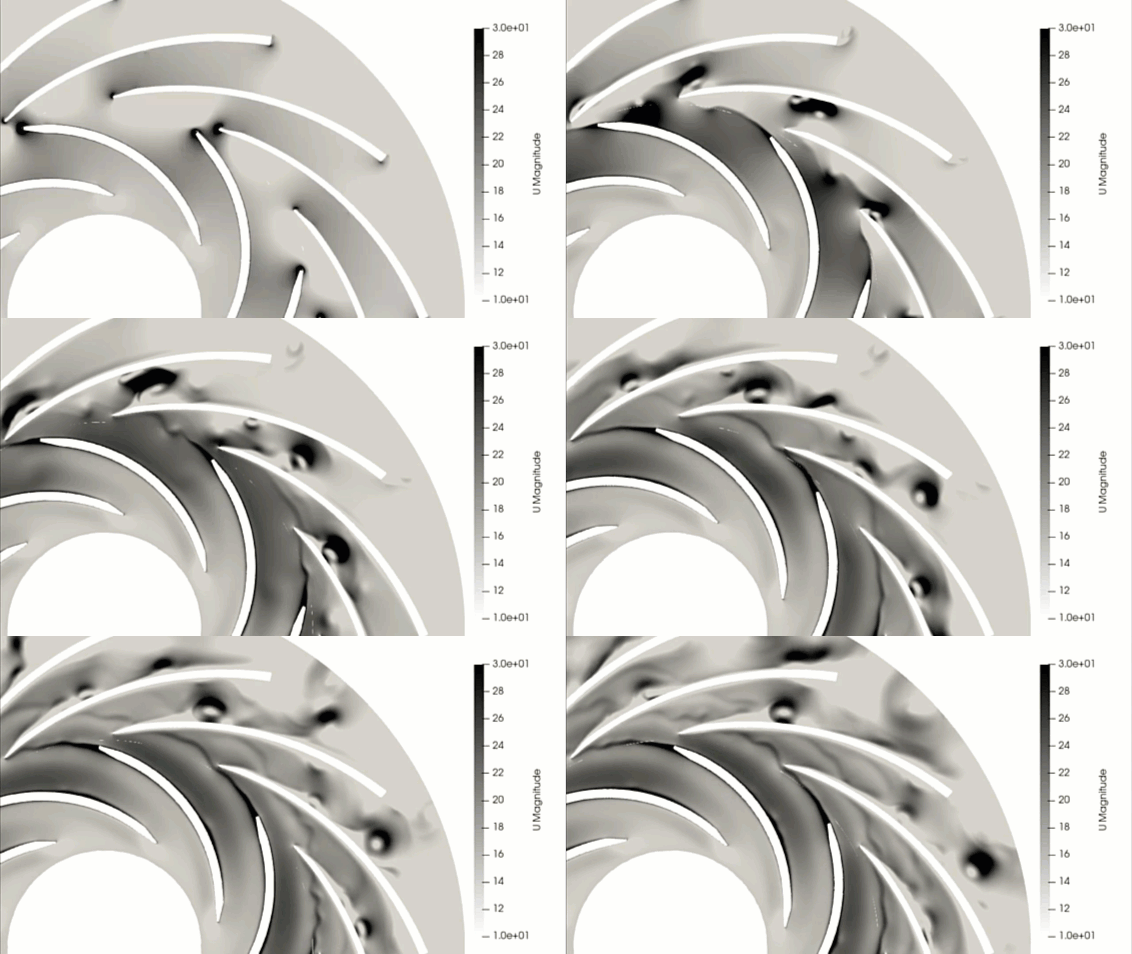
Originally released as open-source software in 2004 by Henry Weller and Chris Greenshields, OpenFOAM was built from the ground up to solve complex continuum mechanics problems. Today, it is managed primarily by the OpenFOAM Foundation and ESI Group, sustained by a massive global community of developers who continuously expand its capabilities.
An Architecture Built on C++ and Physics Cubes
Unlike commercial alternatives that bundle everything into a single visual application, OpenFOAM is a vast collection of modular C++ libraries. It treats physical phenomena—like turbulence, chemical reactions, or heat transfer—as interchangeable building blocks. At its structural core, OpenFOAM relies on the Finite Volume Method (FVM). It divides a 3D fluid domain into millions of tiny control volumes (cubes or polyhedrals) and tracks how mass, momentum, and energy move across their faces. Because it is written in highly object-oriented C++, advanced users can directly write new mathematical equations into the code, translating custom physics into high-performance software.
The Power of Text-Based Customization
To the uninitiated, OpenFOAM can look intimidating. By default, it has no graphical user interface (GUI). Instead, a simulation setup consists of a directory of text files known as “dictionaries.” Engineers define fluid properties, boundary conditions, and solver tolerances by editing these plain text files. While this creates a steep initial learning curve, it grants unparalleled power:
- Total Automation: Text-based configurations mean entire simulation workflows can be automated using simple Python or Bash scripts.
- No Licensing Walls: Because there are no graphical license keys to buy, engineers can deploy OpenFOAM across thousands of cloud-based CPU cores simultaneously via Message Passing Interface (MPI), unlocking massive parallel processing power for free.
Simulating Across Every Domain
OpenFOAM is not limited to basic airflow; its library includes hundreds of pre-built solvers tailored to specific industries. It contains specialized code for multiphase flows (such as mixing oil and water), compressible gas dynamics (for supersonic aerospace engineering), and combustion mechanics (for internal engines and burners). Additionally, OpenFOAM features advanced turbulence modeling tools, including Reynolds-Averaged Navier-Stokes (RANS), Large Eddy Simulation (LES), and Direct Numerical Simulation (DNS), allowing engineers to capture chaotic fluid behaviors with extreme mathematical precision.
The Anchor of the Modern CFD Ecosystem
Because OpenFOAM operates via standard text inputs and outputs, it serves as the ideal foundational engine for broader engineering ecosystems. To bypass the command-line interface, the open-source community frequently pairs OpenFOAM with graphical wrappers like HELYX-OS or BlueCFD-Core. For meshing complex spaces, OpenFOAM includes its own high-powered parallel meshers, snappyHexMesh and blockMesh. Finally, it outputs seamlessly to ParaView, the open-source post-processing standard, creating a completely free, end-to-end simulation pipeline that rivals any multi-million dollar commercial suite on the market.
Author: Caesar Wiratama
Find me on Linkedin
Related Search: FreeCAD Freelancing Service, code_aster Freelancing Service, Calculix Freelancing Service, OpenRadioss Freelancing Service, OpenFOAM Freelancing Service,
Validation studies:
Ahmed Bluff Body OpenFOAM Validation Study: Mesh and Reynolds Number Sensitivity Studies