
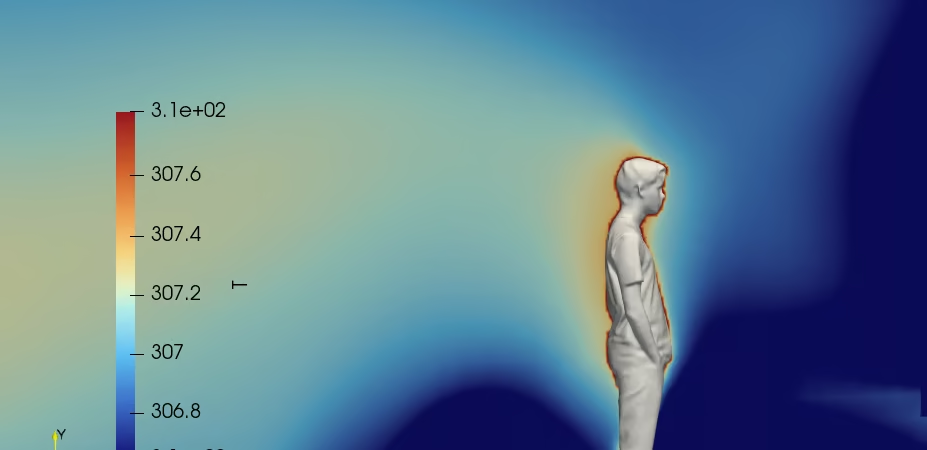
Natural convection HVAC systems are essential, low-energy architectural assets deployed in sustainable building designs, residential spaces, and high-end commercial offices to maintain climate control without relying on forced-air fans. Utilizing technologies like chilled beams, baseboard radiators, and solar chimneys, these systems harness the natural buoyancy of air: hot air expands and rises, while cool, dense air sinks. Achieving uniform comfort through passive circulation is an intricate engineering challenge. Improper placement can lead to localized thermal stagnation, cold air cascading down walls, and excessive temperature stratification. Computational Fluid Dynamics (CFD) provides building services engineers with a high-fidelity virtual environment to track subtle, gravity-driven air currents, map temperature fields, and maximize thermal comfort with high precision.
Technical and Theoretical Description
From a building physics standpoint, HVAC natural convection operates on coupled, buoyancy-driven internal fluid dynamics governed by the three-dimensional Navier-Stokes and energy equations. Unlike forced-air configurations, the fluid velocity field is completely decoupled from mechanical fans and is instead driven entirely by temperature-induced density variations across the space. Because these natural velocities are relatively low but can transition to turbulent plumes near intense heat sources (like human bodies or solar-heated glass), CFD simulations utilize advanced low-Reynolds number turbulence formulations. The Shear Stress Transport (k-omega SST) model is universally applied due to its unique capability to transition smoothly from laminar to turbulent regimes and resolve fragile boundary layers along vertical walls without artificial numerical damping.
The core theoretical focus in modeling passive HVAC systems is the accurate calculation of the buoyancy source term within the momentum equations. For standard indoor configurations with moderate temperature gaps, this is achieved using the Boussinesq approximation, which assumes density is constant everywhere except in the gravity force term. Heat transfer between the solid structures and the indoor air is handled via Conjugate Heat Transfer (CHT). Surface-to-surface radiation, which represents a massive portion of passive heat exchange, is solved using the Discrete Ordinates (DO) model to capture solar radiation streaming through windows. The core performance metrics evaluated include the temperature stratification profile and localized airspeed velocities at a pedestrian level, which are directly fed into empirical plain-text mathematical relations to calculate the Predicted Mean Vote (PMV) and Predicted Percentage of Dissatisfied (PPD) thermal comfort indexes.
Business Value of CFD Implementation
From a commercial perspective, deploying CFD to analyze and refine natural convection systems yields massive capital expenditure (CapEx) savings and directly accelerates project delivery. Green buildings utilizing passive cooling or heating face strict regulatory and certification hurdles, as engineering teams must definitively prove that the passive design will maintain habitable conditions under extreme seasonal peaks. Testing these low-velocity environments using physical, full-scale architectural mock-ups is incredibly slow and expensive. CFD serves as the primary analytical evidence required by global certification bodies, allowing developers to secure building permits and environmental credentials months ahead of schedule.
In terms of operational expenditures (OpEx), a naturally ventilated or passively cooled building directly slashes commercial energy bills. Eradicating heavy mechanical supply fans from the HVAC layout removes a primary source of building power consumption. CFD optimization ensures that passive elements, like chilled beams or thermal mass floors, are sized and placed perfectly to maximize passive heat exchange. This reduces or entirely eliminates the runtimes of secondary mechanical backup loops, delivering massive annual electricity savings. Furthermore, eliminating the noise and vibrations associated with forced-air ducting drastically improves indoor environmental quality, driving up real estate asset values and premium rental yields.
Challenges of CFD in Natural Convection Modeling
Despite its analytical power, simulating HVAC natural convection introduces steep physical and numerical challenges. The foremost obstacle is the intense numerical sensitivity of gravity-driven flows. Because the driving velocities are incredibly low—often under 0.2 meters per second—the fluid momentum is weak. Any minor imbalance in the pressure-velocity coupling or a loose convergence tolerance can introduce unphysical numerical velocities that mask real-world draft risks, invalidating the entire thermal comfort assessment.
Another major hurdle is managing the vast differences in physical scales. The computational domain must encompass the entire multi-story building envelope to capture macro-scale loop circulation, yet the simulation must simultaneously resolve millimeter-scale boundary layer currents crawling up cold windows or rising off electronic equipment. Furthermore, characterizing highly transient environmental boundaries—such as the moving path of solar radiation throughout the day and erratic internal heat gains from occupants—adds complex, time-dependent heat flux variables that are highly prone to numerical instability if the grid layouts are poorly configured.
Solutions for High-Fidelity Simulation
To overcome these low-velocity and multi-scale challenges, modern building engineering workflows combine highly disciplined spatial discretization with specialized numerical stabilization features. Engineers resolve the scale discrepancies by utilizing high-quality structured hexahedral or body-fitted polyhedral grids, with heavy mesh refinement and tight prism layer inflation concentrated along all vertical walls, windows, floors, and heat-generating boundaries. This ensures that the velocity profiles within the thin thermal boundary layer are computed with high fidelity.
To stabilize the coupled density-buoyancy calculations, transient solvers utilizing implicit time-stepping schemes are deployed, with tight convergence criteria enforced for the energy and momentum equations. Real-world weather files and solar positions are automated using time-dependent profile tables that update the boundary conditions hour by hour. Finally, to eliminate identified thermal comfort flaws, engineers use the CFD environment to virtually iterate design modifications, such as introducing decorative wall baffles to disrupt cold air cascading, adjusting the height of baseboard heaters, or refining the sizing of window louvers. Validating the success of these passive interventions in software guarantees a quiet, energy-efficient, and perfectly comfortable architectural blueprint before physical ground is broken.
Author: Caesar Wiratama
Find me on Linkedin