
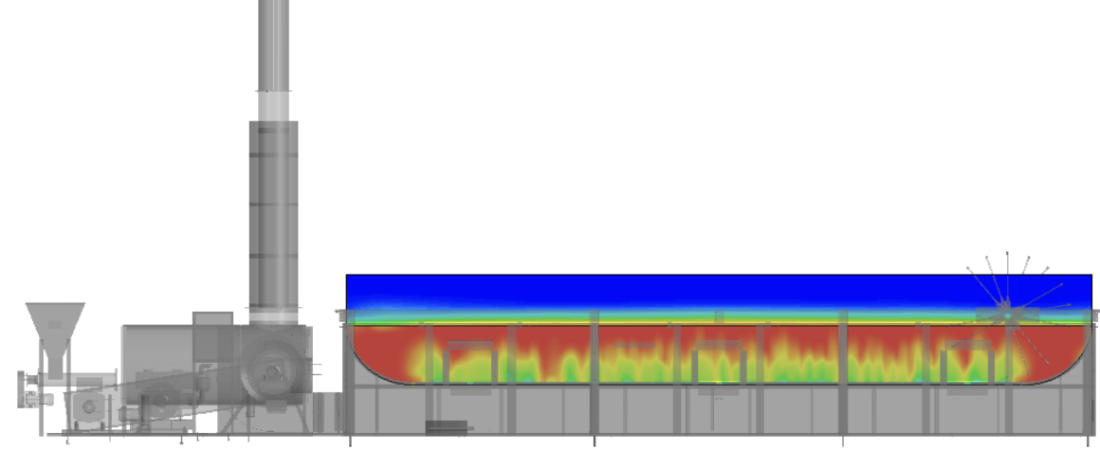
Fluidized bed dryers are essential high-efficiency processing assets utilized across the food industry to dehydrate granular products like grains, milk powders, coffee beans, and dehydrated vegetables. Achieving uniform drying is a delicate balancing act: food products must be dried quickly to prevent spoilage and ensure shelf stability, yet over-exposure to excessive heat can degrade nutritional profiles, alter flavors, and ruin product texture. Traditional empirical tuning relies on trial-and-error testing that can result in expensive product waste. Computational Fluid Dynamics (CFD) provides food process engineers with a non-destructive digital kiln to visualize multiphase heat and mass transfer, map product moisture evaporation, and refine dryer geometries with high precision.
Technical and Theoretical Description
From a physical and chemical perspective, a fluidized bed dryer operates on dense multiphase reacting flow dynamics governed by the three-dimensional, compressible Navier-Stokes equations, energy equations, and chemical species transport equations for vapor distribution. The system handles a continuous gas phase (heated air) and a discrete solid phase (moit food particles). To simulate this highly turbulent and mass-dense environment, CFD applications deploy advanced multiphase modeling. The Eulerian-Eulerian (Two-Fluid Model) treats both the air and food phases as interpenetrating continua, using the kinetic theory of granular flow to compute solid pressures. Alternatively, the Eulerian-Lagrangian Dense Discrete Phase Model (DDPM) tracks discrete particle clusters while accounting for high-volume fraction particle-to-particle collisions.
The drying process relies on a coupled transient framework that tracks simultaneous heat and mass transfer between the fluidizing air and the food particles:
- Fluidization Hydrodynamics: Heated air enters from a bottom plenum through a distributor plate, reaching a velocity that exceeds the minimum fluidization threshold, which suspends the food bed so it behaves like a boiling liquid.
- Convective Heat Transfer: The high-velocity hot air transfers thermal energy into the food particles, a process evaluated using Newton’s Law of Cooling based on localized heat transfer coefficients.
- Moisture Evaporation: Moisture diffuses from the core of the food particle to its surface, where it evaporates into the air stream. This mass transfer is typically modeled via user-defined thin-layer drying kinetics or the Dual-Site evaporation model, calculating water vapor generation source terms in the gas phase.
Business Value of CFD Implementation
From a commercial viewpoint, deploying CFD to analyze and refine fluidized bed dryers yields substantial capital expenditure (CapEx) savings and directly drives down food plant operational expenditures (OpEx). During the development of a new industrial dryer or a product line changeover, CFD acts as a risk-free virtual testing laboratory. Engineers can simulate changes to air distributor perforation patterns, plenum shapes, and weir heights in software, compressing project timelines and avoiding the extreme financial risks of fabricating faulty physical stainless-steel machinery.
In terms of OpEx, CFD optimization directly maximizes product quality, consistency, and energy efficiency. Eliminating localized dead zones—areas where flow is stagnant and particles clump together—prevents the localized overheating and scorching of heat-sensitive food products, which dramatically slashes product reject rates. Furthermore, by ensuring uniform airflow distribution through CFD, the drying cycle is accelerated and thermal energy usage is minimized. This significantly lowers the factory’s natural gas or electricity consumption, delivering massive utility savings and boosting throughput to maximize the facility’s return on investment.
Challenges of CFD in Food Bed Dryer Modeling
Despite its analytical power, simulating a fluidized bed dryer for food processing introduces steep numerical and physical challenges. The primary obstacle is the variable, non-spherical, and sticky nature of food particles. Unlike uniform industrial catalysts, food materials like sliced vegetables, tea leaves, or sticky powder agglomerates possess highly irregular shapes and varying densities, which constantly change as the product loses moisture during the drying cycle. Modeling these changing, irregular shapes using standard rigid spherical drag laws can severely distort predictions of bed expansion and air-particle contact time.
Another major hurdle is the deep physical coupling and tracking of the falling-rate drying period. As a food particle dries, moisture diffusion from the internal core to the surface becomes the limiting factor, which alters the material’s bulk density, internal thermal conductivity, and structural shrinkage. Simulating this coupled, time-dependent internal transport alongside phase-change moisture evaporation introduces highly sensitive numerical source terms that are exceptionally prone to instability. Additionally, modeling the low-velocity fluidization of high-cohesion powders (categorized as Geldart Group C powders) requires accounting for inter-particle van der Waals forces to accurately predict and prevent channel-flow anomalies.
Solutions for High-Fidelity Simulation
To overcome these dense multiphase and transient evaporation challenges, modern food engineering workflows leverage advanced sub-grid physical models and optimized meshing strategies. Engineers resolve the changing material properties by implementing custom, user-defined moisture-dependent functions for particle density, shrinkage, and sphericity within the Eulerian-Lagrangian or DDPM framework. Internal mesh discretization can be applied inside individual computational particle parcels to accurately calculate intra-particle moisture diffusion and temperature gradients during the falling-rate drying period.
To manage the massive computational load of tracking millions of tumbling food particles, simulations group individual particles into statistical computational parcels. Computational domains are constructed using high-quality hexahedral or polyhedral grids, with heavy grid refinement applied at the air distributor plate holes and the splash zone just above the dense bed to capture steep moisture and velocity gradients. Finally, to eliminate identified fluidization flaws, engineers utilize the CFD environment to virtually iterate flow-correcting devices, such as adding mechanical agitators or implementing pulsed-gas fluidization techniques. Validating the success of these operational modifications in software ensures a stable, high-throughput, and energy-efficient food processing blueprint before moving to physical manufacturing.
Author: Caesar Wiratama
Find me on Linkedin