
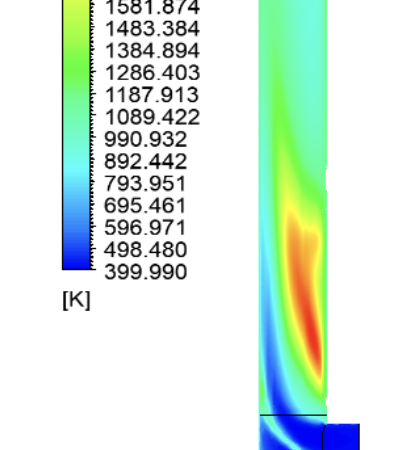
Biomass boilers and gasifiers are vital renewable energy assets deployed across the industrial and power sectors to displace fossil fuels and reduce net carbon emissions. Unlike traditional fuels, biomass resources—such as wood pellets, agricultural residues, and municipal green waste—possess highly variable moisture contents, low energy densities, and irregular shapes. These unpredictable fuel characteristics often lead to uneven combustion, localized fouling, and fluctuating thermal efficiencies. Computational Fluid Dynamics (CFD) provides bioenergy engineers with a risk-free virtual furnace to simulate multi-phase thermochemical reactions, analyze complex airflow mixing, and refine system geometry with high precision.
Technical and Theoretical Description
From a thermal-chemical perspective, biomass conversion operates on highly coupled, multi-phase reacting fluid dynamics governed by the three-dimensional, compressible Navier-Stokes equations, the energy equation, and chemical species transport equations. The system handles a continuous phase (turbulent air and flue gas) and a discrete phase (solid biomass particles). Because the secondary and tertiary air injectors generate intense swirling and mixing inside the furnace, CFD simulations utilize advanced turbulence models, most commonly the Reynolds-Averaged Navier-Stokes (RANS) Realizable k-epsilon or Shear Stress Transport (k-omega SST) models to capture flow separation and recirculation zones.
The transformation of solid biomass into thermal or chemical energy is solved using a sequential, multi-step chemical reaction framework through Eulerian-Lagrangian particle tracking:
- Moisture Evaporation: A highly endothermic phase where high moisture content is driven out of the biomass particle, a process governed by the Spalding mass transfer number.
- Devolatilization / Pyrolysis: The thermal decomposition of dry solid biomass into volatile gases and solid char, typically modeled using multi-step Arrhenius kinetics to account for the high volatile content characteristic of biomass.
- Volatile Combustion: Gas-phase reactions where volatile species mix with air. This is governed by turbulence-chemistry interaction models like the Eddy Dissipation Concept (EDC), solving species transport for carbon monoxide, carbon dioxide, water vapor, and intermediate hydrocarbons.
- Char Conversion: The heterogeneous oxidation or gasification of the remaining carbon matrix, modeled via diffusion-kinetic mechanisms where oxygen, carbon dioxide, or water vapor react directly with the solid particle surface.
Thermal radiation, which dominates heat transfer to the water walls, is computed using high-fidelity models such as the Discrete Ordinates (DO) model, factoring in the unique scattering and absorption coefficients of the dense, ash-laden gas.
Business Value of CFD Implementation
From a commercial viewpoint, deploying CFD in biomass system design yields massive capital expenditure (CapEx) savings and directly drives down plant operational expenditures (OpEx). During a fuel conversion project—such as retrofitting a coal plant to burn 100% biomass—CFD serves as a rapid virtual prototyping environment. Engineers can evaluate dozens of fuel injector angles, grate speeds, and overfire air layouts in software, drastically compressing engineering timelines and avoiding the catastrophic financial risks of physical structural modifications.
In terms of OpEx, a refined combustion profile directly maximizes boiler efficiency and fuel economy. Minimizing unburned carbon in the bottom and fly ash (Loss on Ignition) ensures that the plant extracts maximum thermal energy from variable, low-cost biomass feedstocks, yielding substantial annual fuel savings. Furthermore, tuning the combustion profile via CFD to maintain stable, moderate flame temperatures limits the formation of thermal nitrogen oxides (NOx). This reduces the operational consumption of expensive chemical reagents in downstream emissions control systems, delivering massive compliance-related savings while satisfying strict global environmental mandates.
Challenges of CFD in Biomass Modeling
Despite its analytical power, simulating biomass conversion introduces steep numerical and physical challenges. The foremost obstacle is the extreme geometric and physical irregularity of the fuel. Biomass particles are rarely uniform spheres; they exist as chips, fibers, or cylinders with highly anisotropic thermal conductivities and non-spherical drag coefficients. Modeling these irregularly shaped particles using standard spherical drag laws leads to highly inaccurate predictions of particle trajectories and residence times inside the furnace.
Another major hurdle is accurately capturing the non-linear physics of structural degradation, specifically ash slagging, fouling, and high-temperature corrosion. Biomass ash often contains high concentrations of alkali metals, such as potassium and sodium, which significantly lower the ash melting temperature. When these molten ash particles impact furnace walls and superheater tubes, they stick and form highly insulating slag layers. Simulating this transient accumulation, the subsequent reduction in heat transfer, and the chemical corrosion of the steel tubes introduces highly sensitive, non-linear boundary constraints that are exceptionally prone to numerical instability if poorly configured.
Solutions for High-Fidelity Simulation
To overcome these irregular shape and multiphase challenges, modern bioenergy engineering workflows combine advanced numerical strategies with tightly integrated solver physics. Engineers resolve the non-spherical particle problem by implementing custom drag laws and heat transfer correlations (such as the Ganser or Haider-Levenspiel formulations) that explicitly factor in particle sphericity and aspect ratios. Biomass fuel blends are modeled using multi-component discrete distributions, where particles are categorized into realistic statistical size and shape bins based on actual fuel sampling data.
To accurately predict ash deposition and slagging risks, simulations integrate custom user-defined functions (UDFs) that evaluate the thermal and kinetic state of ash particles upon wall impact against the empirical ash fusion temperatures of the specific biomass blend. Computational domains are constructed using high-quality polyhedral or hex-dominant grids, with heavy grid refinement applied around the fuel feeders and air injection nozzles to capture steep temperature and chemical species gradients. Finally, the extracted radiative and convective heat flux profiles are mapped directly onto the boiler’s steam-side network, allowing engineers to verify uniform heat absorption and eliminate localized tube-overheating hotspots before the physical boiler is fired up.
Author: Caesar Wiratama
Find me on Linkedin