
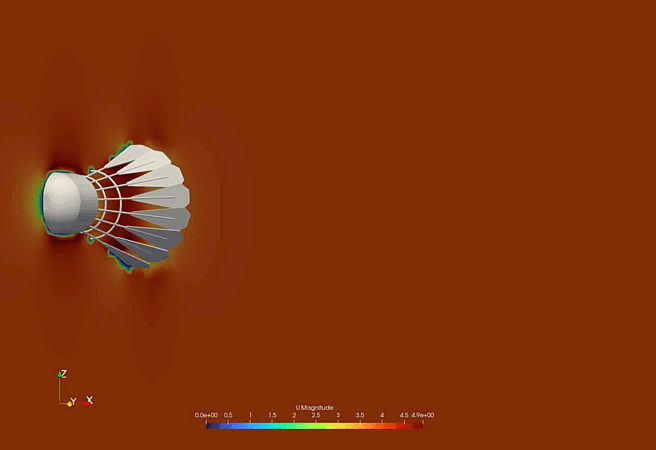
The shuttlecock is one of the most aerodynamically unique projectiles in sports engineering, characterized by its high drag, rapid stabilization, and distinct deceleration profile. Unlike a standard ball, a shuttlecock must flip instantly upon racket impact and establish a stable, spinning flight path. Its performance dictates the speed, trajectory, and overall dynamics of a badminton match. Traditional testing relies on expensive high-speed wind tunnels and automated pitching machines. Computational Fluid Dynamics (CFD) provides sports engineers with a high-fidelity digital laboratory to analyze complex wake formations, evaluate spinning flight mechanics, and optimize materials with extreme precision.
Technical and Theoretical Description
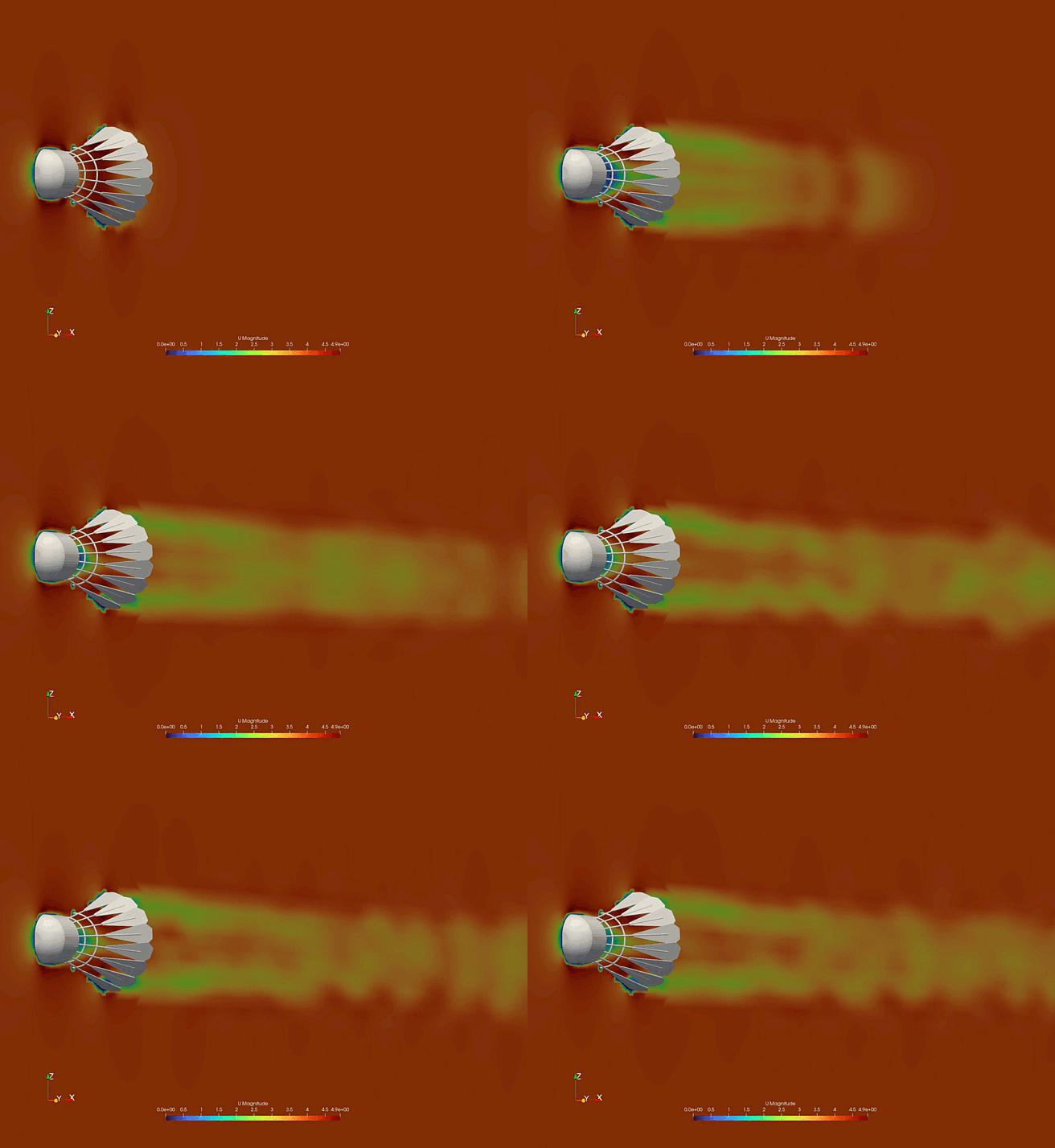
From a fluid mechanics perspective, a shuttlecock operates under external fluid dynamics characterized by a high drag coefficient, a complex wake structure, and strong rotational behavior. The flow field around the projectile is governed by the three-dimensional Navier-Stokes equations. Because air rushing through the porous feather or synthetic skirt generates intense localized turbulence and micro-vortices, designers employ advanced transient turbulence closures. The Reynolds-Averaged Navier-Stokes (RANS) Shear Stress Transport (k-omega SST) model is widely used for near-wall accuracy, while Detached Eddy Simulation (DES) or Large Eddy Simulation (LES) is applied to resolve the highly chaotic, fluctuating turbulent wake trailing behind the skirt.
The primary theoretical focus in shuttlecock aerodynamics is the evaluation of the drag coefficient (Cd), lift coefficient (Cl), and the rotational spin rate. A shuttlecock’s flight relies on the drag force equation, written in plain text as: Drag equals 0.5 times air density times velocity squared times the drag coefficient times the frontal reference area. As the shuttlecock flies, air passes both around the outer perimeter and through the gaps of the feathered skirt. This venting creates a low-pressure zone inside the cone, generating massive pressure drag. Additionally, the angled orientation of the feathers forces the shuttlecock to spin along its longitudinal axis. This spin rate, measured in revolutions per minute, creates a gyroscopic stabilization effect that keeps the cork nose pointing forward, directly influencing the trajectory decay curve.
Business Value of CFD Implementation
From a commercial standpoint, deploying CFD in sports equipment design yields massive cost savings and accelerates product time-to-market. Manufacturing high-quality natural feather shuttlecocks is an expensive, labor-intensive process that requires sorting specific goose or duck feathers. CFD acts as a rapid virtual prototyping tool, allowing manufacturers to test dozens of synthetic skirt geometries—altering blade angles, stem thicknesses, and perforation patterns—in software. This drastically reduces the number of physical molding iterations and cuts R&D expenditures.
In terms of operational and market value, CFD optimization allows brands to engineer synthetic shuttlecocks that precisely mimic the flight characteristics of premium natural feathers. Synthetic shuttlecocks are highly desired by consumers and clubs due to their superior durability and lower lifecycle costs. By matching the flight trajectory, spin deceleration, and impact feel of natural feathers using software-driven designs, manufacturers can successfully capture the lucrative mass-market and tournament sectors, maximizing corporate revenue and brand equity in a highly competitive sports industry.
Challenges of CFD in Shuttlecock Modeling
Despite its analytical power, simulating a shuttlecock introduces steep physical and computational challenges. The foremost obstacle is the complex, multi-scale geometry of the skirt. Natural feathers consist of intricate, porous micro-structures with thousands of interlocking barbs. Modeling this exact geometry creates an unmanageable mesh count. Even for synthetic variants, the thin-walled, highly curved overlapping blades require millimeter-scale grid resolution, demanding immense computational power to capture localized flow separation.
Another major hurdle is modeling the high-velocity deformation and rotational physics. Upon a powerful smash, a shuttlecock can reach initial speeds exceeding 400 kilometers per hour. Under this massive aerodynamic pressure, the skirt undergoes structural deformation, temporarily collapsing inward. This deformation alters the frontal reference area and changes the drag characteristics dynamically during flight. Simulating this coupled behavior requires advanced Fluid-Structure Interaction (FSI) solvers where the transient fluid pressure field deforms the material mesh, and the rotating frame of reference must be updated continuously without causing numerical instability.
Solutions for High High-Fidelity Simulation
To overcome these geometric and structural challenges, modern sports engineering workflows utilize specialized numerical techniques and coupled physics solvers. Engineers resolve the micro-porosity of natural feathers by implementing calibrated porous media zones, using directional pressure-drop coefficients instead of meshing every individual barb. For synthetic designs, unstructured overset (chimera) meshing or Sliding Mesh techniques are applied, allowing the shuttlecock domain to rotate at thousands of RPM relative to the stationary far-field wind tunnel grid.
To capture the physical deformation of the skirt during high-speed smashes, transient CFD solvers are tightly coupled with non-linear Finite Element Analysis (FEA) software. This two-way FSI workflow ensures that as the air pressure compresses the skirt, the aerodynamic forces are recalculated based on the deformed shape in real time. Finally, to match real-world tournament conditions, engineers virtually iterate the design by testing different material densities and blade angles in the software. Validating these modifications digitally guarantees that the final manufactured shuttlecock achieves the perfect balance of rapid stabilization, high drag deceleration, and long-lasting durability.
Author: Caesar Wiratama
Find me on Linkedin