
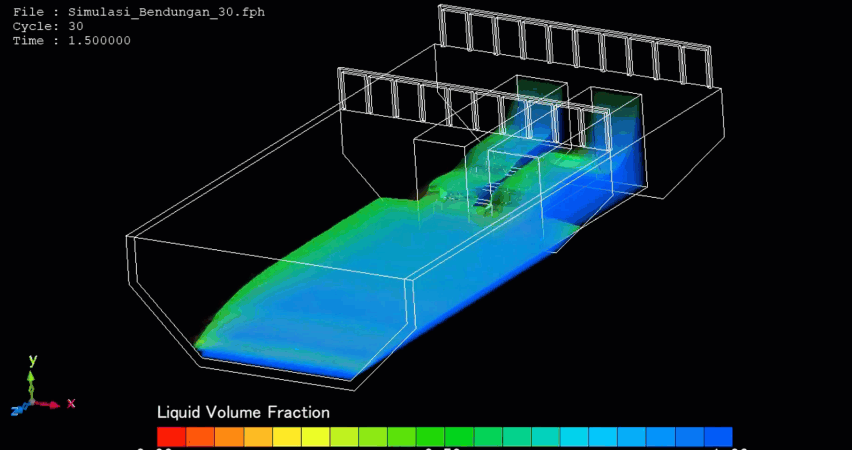
Dams are massive, high-consequence infrastructure assets designed to manage immense hydraulic energy for flood control, water storage, and hydropower generation. Because a failure can have catastrophic economic and environmental consequences, ensuring structural and hydraulic safety during extreme weather events is paramount. Traditional design methods rely heavily on empirical formulas or highly expensive, time-consuming physical scale models. Computational Fluid Dynamics (CFD) provides engineers with a high-fidelity digital laboratory to visualize, analyze, and optimize dam flow behavior, ensuring long-term resilience under diverse operational scenarios.
Technical and Theoretical Description
From a fluid mechanics perspective, a dam system operates on complex, multi-phase fluid dynamics, primarily characterized by open-channel free-surface flows (air-water interfaces) and transient high-velocity regimes. To simulate these environments accurately, CFD applications solve the three-dimensional Navier-Stokes equations across the structural domain. Because water plunging down a spillway or exiting a discharge tunnel exhibits intense turbulence, designers employ advanced turbulence models—most commonly the Reynolds-Averaged Navier-Stokes (RANS) formulations like the k-ω SST model—to capture turbulent kinetic energy, flow separation, and dissipation rates. For highly transient and chaotic phenomena like hydraulic jumps or energy dissipator impact zones, Large Eddy Simulation (LES) is applied to resolve large-scale turbulent structures.
A critical theoretical requirement in dam modeling is tracking the dynamic boundary between air and water, which is achieved using the Volume of Fluid (VOF) method. The VOF approach tracks the volume fraction of each fluid in every computational cell, allowing for the precise modeling of waves, nappe shapes, and aerated flow regions. The core theoretical metrics evaluated include the cavitation index, pressure distributions along spillway chutes, and the kinetic energy dissipation rate within the stilling basin. Mapping these parameters allows engineers to ensure that the kinetic energy of the water is safely dissipated before it reaches the natural riverbed downstream.
Business Value of CFD Implementation
From a commercial viewpoint, deploying CFD across dam design and rehabilitation projects yields massive capital expenditure (CapEx) savings and significantly mitigates structural risk. Historically, physical scale models took months to build and modify, costing hundreds of thousands of dollars per iteration. CFD allows engineers to rapidly test dozens of design variations—such as altering spillway gate configurations, training wall heights, or flip bucket angles—in a matter of days. This drastically compresses the engineering timeline and reduces upfront R&D costs.
In terms of long-term operational expenditures (OpEx), CFD helps prevent catastrophic structural degradation. By identifying areas prone to cavitation or localized high-velocity impacts early, companies can optimize geometries virtually, avoiding the need for incredibly expensive post-construction concrete remediation. For existing aging dams, CFD simulations enable asset owners to safely assess spillway capacity upgrades required by modern climate data without decommissioning the facility, maximizing the return on investment and extending the operational lifespan of the asset.
Challenges of CFD in Dam Hydraulic Modeling
Despite its capability, simulating a full dam system introduces immense multi-scale physical and computational challenges. The primary obstacle is the stark discrepancy in geometric scales. A reservoir can stretch for kilometers, yet the aeration slots on a spillway or the boundary layers near control gates require millimeter-scale mesh resolution to capture localized shear and pressure gradients accurately. This creates massive grid sizes that demand significant computational power.
Additionally, capturing the transition of flow regimes—such as the rapid shift from slow-moving subcritical flow in the reservoir to torrential supercritical flow down a spillway, followed by a violent hydraulic jump—demands highly robust numerical stabilization. Modeling air entrainment (white water) along spillways is another significant hurdle; as air mixes with water, it alters the fluid density and bulk compressibility, which directly impacts energy dissipation calculations. If these complex multiphase physics are oversimplified, the simulation can yield inaccurate predictions of water levels and structural loading forces.
Solutions for High-Fidelity Simulation
To overcome these multi-scale challenges, modern simulation workflows utilize a combination of specialized physical sub-models and advanced, adaptive meshing strategies. Engineers address the scale discrepancy by utilizing multi-zone meshing techniques, applying coarse grids in the deep reservoir and dense boundary layer cell inflation paired with Adaptive Mesh Refinement (AMR) in regions with steep velocity and pressure gradients, such as gate openings and spillway lips.
To balance computational efficiency with numerical accuracy during transient high-flow events, high-order advection schemes are paired with dynamic time-stepping algorithms that strictly control the Courant-Friedrichs-Lewy (CFL) condition. Furthermore, to accurately predict air entrainment along the spillway, advanced sub-grid aeration models are integrated with the VOF framework to calculate bulk density changes correctly. Finally, empirical cavitation index thresholds and structural pressure mapping are directly extracted from the fluid domain and coupled with Finite Element Analysis (FEA) software. This fluid-structure interaction (FSI) workflow ensures that structural engineers can verify concrete stress limits under realistic, transient hydraulic loads.
Author: Caesar Wiratama
Find me on Linkedin